
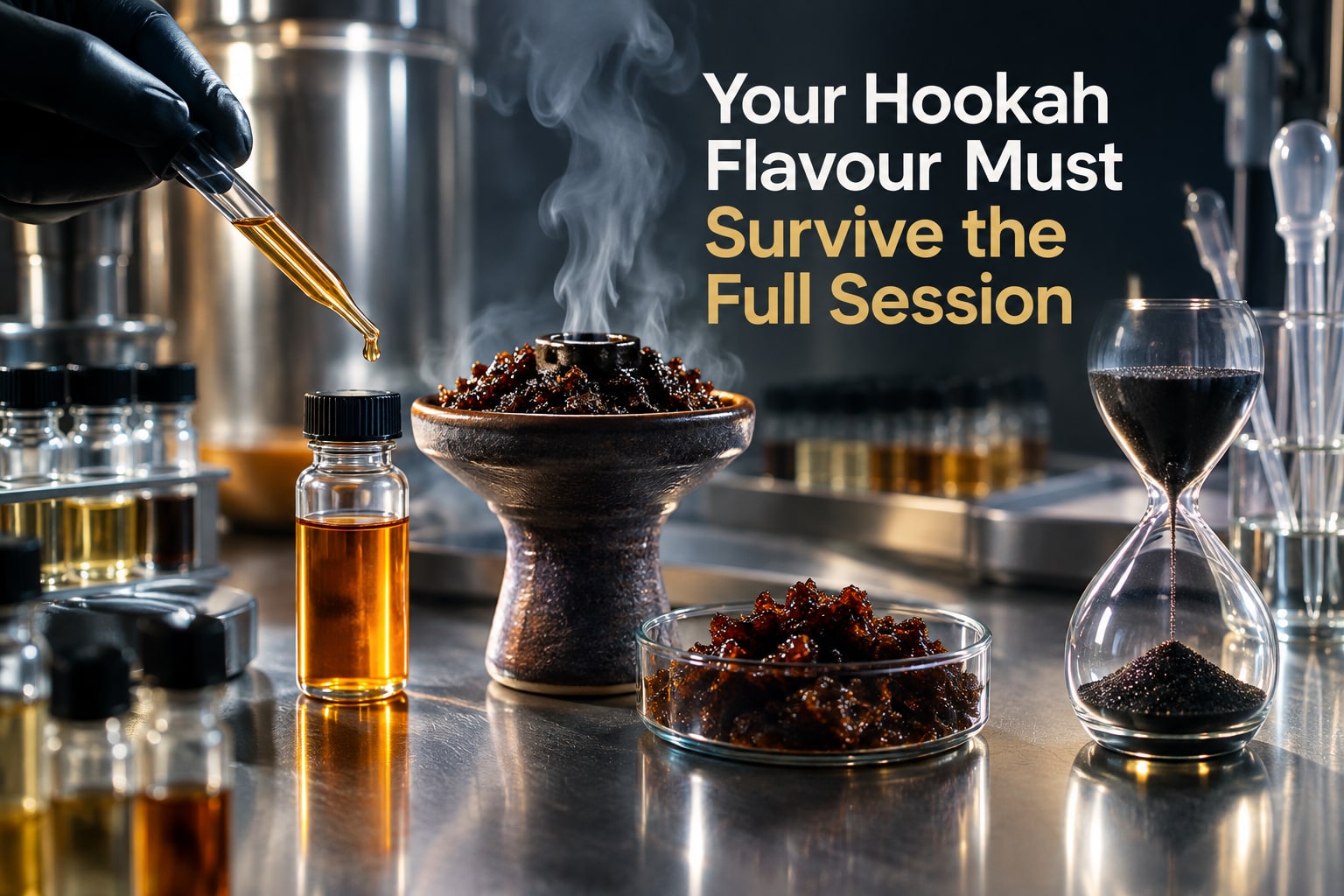
A flavour that smells powerful in a bottle can fade early, turn harsh under charcoal heat, or behave differently in a glycerin-rich base. By the end, you will know how to define the product, brief a supplier, run a controlled session test, compare technical evidence, and approve a flavour for production and its destination market.
Key takeaways
- Specify the finished hookah format, base, and heating method first.
- Give the laboratory target notes, dosage limits, session length, and packaging details.
- Test flavour from the first draw through the end of the session.
- Request technical evidence before approving a liquid flavour manufacturer.
Define the Hookah Product Before You Request a Flavour
Before you ask for a flavour, identify the finished hookah format, its base, and how it will be heated. To customize flavour for B2B hookah sheesha brands, a supplier must know whether it is developing a molasses mixture, an herbal product, a nicotine liquid, or only a flavour concentrate.
| Format | Base | Use conditions |
|---|---|---|
| Shisha tobacco | Tobacco, glycerol or molasses, water, nicotine | Bowl size, foil or heat-management device, charcoal type, target mixture temperature, and session duration |
| Herbal or nicotine-free molasses | Botanical material, glycerol, molasses, water, sweetener | Heating profile, smoke density target, bowl setup, and intended claim or market |
| Hookah liquid | Propylene glycol, vegetable glycerin, nicotine or botanical extract, water and additives | Electronic coil, power range, aerosol temperature, device type and puff duration |
| Flavour concentrate | Flavour materials in a carrier | Dilution rate, finished-product base and compatibility with heated inhalation |
Do not send a beverage flavour brief for a heated waterpipe product. Propylene glycol, vegetable glycerin, water, sweeteners, nicotine, tobacco extracts and colour alter viscosity, flavour release, aerosol generation and heat response. Glycerol and propylene glycol are formulation materials, not interchangeable neutral carriers.
State the charcoal format, bowl and foil arrangement, target smoke temperature, session length and destination market. A flavour that succeeds in an electronic aerosol system can fail in a charcoal-heated tobacco mixture. Request finished-mixture or generated-aerosol evaluation; a concentrate’s ingredient list does not predict emissions.
Also separate flavour legality in the manufacturing country from finished-product classification and import rules in the destination market.
Build a Brief That a Flavour Laboratory Can Develop
Give the laboratory a development brief that identifies the material you are buying: a flavour concentrate, finished hookah liquid, molasses or glycerin-based mix, or fragrance. A beverage flavour or fragrance is not automatically suitable for a heated tobacco or nicotine product.
- Product format: shisha tobacco, herbal molasses, nicotine-free mix, hookah liquid, or another inhalable preparation
- Tobacco or nicotine base, botanical extracts, nicotine strength, water, sweeteners, colour, propylene glycol and vegetable glycerin
- Target flavour profile, sweetness, cooling, intensity, colour and any prohibited or required ingredients
- Molasses or glycerol content, target viscosity and expected flavour dosage range
- Bowl size, foil or heat-management device, charcoal type and size, target smoke temperature, and session duration
- Destination market, product classification, label claims and launch timeline
A hookah sheesha flavour manufacturer then converts the brief into laboratory trials and sends coded samples with dosage instructions and a specification. Evaluate each sample in the intended base and charcoal-and-bowl process, not only in a cold liquid; water does not reliably remove carbon monoxide, aldehydes, polycyclic aromatic hydrocarbons or fine particles.
Request finished-mixture or generated-aerosol testing where applicable.
Record your sensory decision against defined criteria, return one consolidated revision brief, and repeat trials until the profile is fixed. Before production approval, confirm the destination-market classification, ingredient and packaging documentation, pilot-batch performance, batch tolerances and release tests.
Approve the commercial formula only after the pilot matches the accepted sample and the supplier’s records identify the formula version, lot and manufacturing process.
Control the Formula and Test Flavour Across the Full Session
A fair comparison starts with a locked finished mixture, not an equal number of flavour drops. Fix the propylene glycol-to-vegetable glycerin ratio, water, sweetener, tobacco or botanical base, nicotine level, bowl, packing density and heating method. Change one variable at a time, or you will not know whether a flavour revision caused the improvement.
| Variable | Keep constant or record | Why it changes the result |
|---|---|---|
| Propylene glycol and vegetable glycerin | Record the exact ratio, total percentage and batch mass | PG affects flavour release; VG affects viscosity, moisture retention and aerosol volume |
| Heating system | Use the same charcoal mass, heat-management device, foil-hole pattern and target bowl temperature | More heat can increase aerosol output, exhaust volatile notes early and create burnt or irritating notes |
| Mixture preparation | Use the same mixing time, rest period, moisture content, bowl geometry and packing density | Uneven distribution produces false differences between samples |
| Session point | Score the opening, midpoint and late session separately | A bright top note can disappear while sweet, spicy or tobacco-masking notes remain |
| Session duration | End each run at a defined minute or defined bowl condition | A sample that wins at 10 minutes may become harsh before the intended session ends |
Use coded samples and the same tester sequence to reduce brand bias. Record aroma, flavour intensity, sweetness, harshness, burnt character and tobacco masking at each time point; do not accept a single immediate tasting as session approval.
Pair sensory scores with batch evidence. Use GC-MS or GC-FID for volatile-marker profiles, and HPLC or a validated gravimetric or chemical method for glycerol, propylene glycol, nicotine or other non-volatile components. Specify extraction, dilution and injection conditions, then test the finished mixture or generated aerosol; a concentrate’s ingredient list cannot predict heated emissions.
Compare Liquid Flavour Manufacturers by Technical Evidence
A liquid flavour manufacturer for hookah products must show performance in the customer’s actual glycerin-based mixture, not just a pleasant smell in a cold sample. Ask for trials using the intended propylene glycol, vegetable glycerin, tobacco or botanical extract, sweetener, bowl, heat management and charcoal process.
Water does not make smoke safe, and charcoal can add carbon monoxide and combustion-related toxicants, so sensory approval alone is incomplete.
| Evidence | What to examine | Warning sign |
|---|---|---|
| Application trial | Flavour at the proposed dosage in your finished base, across the session | A universal percentage with no base validation |
| Heat compatibility | Sensory results plus testing or technical discussion covering aldehydes, volatile organic compounds and other emissions | “Food-grade” presented as proof of inhalation suitability |
| Quality control | Consistent colour, odour, viscosity, lot coding and retained samples | No batch-specific certificate of analysis |
| Regulatory support | Ingredient status, market classification and claim review | Automatic compliance claims for every destination |
Put these documents in the supplier specification:
- Ingredient or composition declaration, including carrier solvents and allergens where applicable
- Certificate of analysis identifying the batch or lot
- Safety Data Sheet and handling instructions
- Recommended dosage range validated in your base, plus storage conditions and shelf life
- Manufacturing-country ingredient-status statement and destination-market regulatory information
- Written distinction between the flavour concentrate and the finished shisha mixture
A B2B flavour supplier in Colombo still needs destination-country data; location does not decide whether tobacco, nicotine-free herbal shisha or the concentrate is legal to sell or import. Khattri Aromas LLP should be assessed against this evidence, not against a catalogue description.
Separate Sensory Approval from Safety, Compliance and Scale-Up
Do not sign off a hookah flavour because the panel likes it. Approve three separate gates: destination-market legality, safety and specification, then pilot and commercial reproducibility.
1. Classify the finished product in the destination country: tobacco shisha, herbal molasses, nicotine-free shisha, hookah liquid or another inhalable preparation. Check flavour-ingredient legality in the manufacturing country, finished-product notification or authorisation rules at destination, and import and transport requirements for the concentrate.
2. Match the product category to its rules before approving the concept or label claim. In the United States, hookah tobacco falls under FDA tobacco-product requirements, which can include product authorisation, ingredient reporting, manufacturing and packaging obligations. In the European Union, characterising-flavour restrictions depend on product category and national implementation.
3. Keep sensory approval separate from the technical file. Request the concentrate’s composition or ingredient declaration, allergen statement where applicable, certificate of analysis, lot number, dosage range validated in the customer’s base, storage conditions, shelf life and safety documentation. “Food-grade” alone does not prove suitability for a heated inhalation product.
4. Test the approved formula in a pilot batch under production conditions. Check flavour output alongside emissions compatibility, including carbon monoxide, aldehydes, volatile organic compounds, polycyclic aromatic hydrocarbons and fine particles where the market or risk assessment requires it.
5. Release commercial manufacture only after identity and batch controls match the specification. Use GC-MS or GC-FID for volatile markers and HPLC or validated gravimetric methods for non-volatile components such as nicotine, glycerol and propylene glycol; record the extraction and injection conditions so results remain comparable.
Frequently asked questions
What should you define before requesting a hookah flavour?
Identify whether the finished product is molasses, herbal, nicotine liquid, or flavour concentrate. Include its base and heating method.
What belongs in a B2B hookah flavour brief?
State the target sensory profile, finished format, base ingredients, expected dosage, pack type, session length, and technical constraints.
How should you test a customized hookah flavour?
Evaluate the flavour across the full session, from the first draw through the end, rather than approving it from a single opening taste.
How do you compare liquid flavour manufacturers for hookah products?
Compare formulation evidence, sample traceability, testing records, documentation, production controls, and scale-up support.
When should sensory approval be separated from safety and compliance approval?
Treat taste approval as a separate gate from safety, regulatory documentation, batch control, and commercial-scale manufacturing approval.