“Fragrance for attar” can mean a scent compound, a diluted perfume oil, or a traditional aromatic concentrate, so the product name alone is not a usable specification. By the end, you will know how to define the carrier and dosage, verify skin-safety documents, test performance in finished oil, and compare a Colombo manufacturer against measurable requirements.
Key takeaways
- Define the attar format, carrier and finished dosage before requesting samples.
- Ask for an IFRA certificate, SDS, allergen declaration and batch COA.
- Test scent, colour, stability and skin compatibility at the intended dosage.
- Request sample specifications, lead times, minimum order quantities and batch controls.
What “fragrance for attar” actually means
“Fragrance for attar” can mean four different things: a traditional hydro-distilled aromatic concentrate, often distilled into sandalwood oil; a modern non-alcoholic perfume oil; a fragrance compound supplied for dilution; or a finished oil ready for filling. Put the intended meaning, carrier, and finished dosage in the brief before you request samples.
| Option | What it means | Key distinction |
|---|---|---|
| Traditional attar | Aromatics hydro-distilled into sandalwood oil or another fixed oil | The distillation process and sandalwood carrier are part of the product |
| Modern perfume oil | Fragrance blended into jojoba, fractionated coconut oil, or another oil | Non-alcoholic, but not necessarily traditionally distilled |
| Concentrated perfume oil | A strong compound intended for controlled dilution | It is not a finished attar until the carrier and dosage are specified |
| Alcohol-based perfume or parfum | Fragrance dissolved in ethanol; parfum denotes a higher finished concentration | Requires alcohol-system clarity, chill-haze, and precipitation checks |
| Bakhoor fragrance | A compound designed for heated incense or scented material | Heat performance does not establish skin safety |
Fragrance for parfum describes an application, not proof of superior quality. Parfum, eau de parfum, and eau de toilette differ mainly in finished concentration and formula design; the safety limit follows exposure and product category. An alcohol, detergent, incense, or air-care fragrance is not automatically suitable for skin-contact attar.
Require skin-use evaluation, carrier compatibility, solubility, colour, oxidation, and odour-change data before approval.
How the carrier and blending method shape the finished attar
A high quality fragrance for attar changes significantly with its carrier. The brief must name that carrier before approval because the same concentrate can smell, spread, colour, and remain stable differently in each base.
| Option | Odour and skin feel | Colour, oxidation, solubility and stability |
|---|---|---|
| Sandalwood oil | Adds a warm woody signature and a rich, oily feel | Yellow to amber; natural constituents can oxidize; test clarity and long-term odour stability |
| Jojoba oil | Low-odour, smooth, cushion-like feel | Pale yellow; strong oxidative stability; confirm concentrate solubility at the planned dosage |
| Fractionated coconut oil | Nearly neutral odour and light, dry slip | Clear to very pale; good oxidation resistance and useful solvency for many oil-soluble materials |
| Isopropyl myristate (IPM) | Very light, fast-spreading, low-tack feel | Nearly colourless; useful solvency, but check staining, skin compatibility, and separation over time |
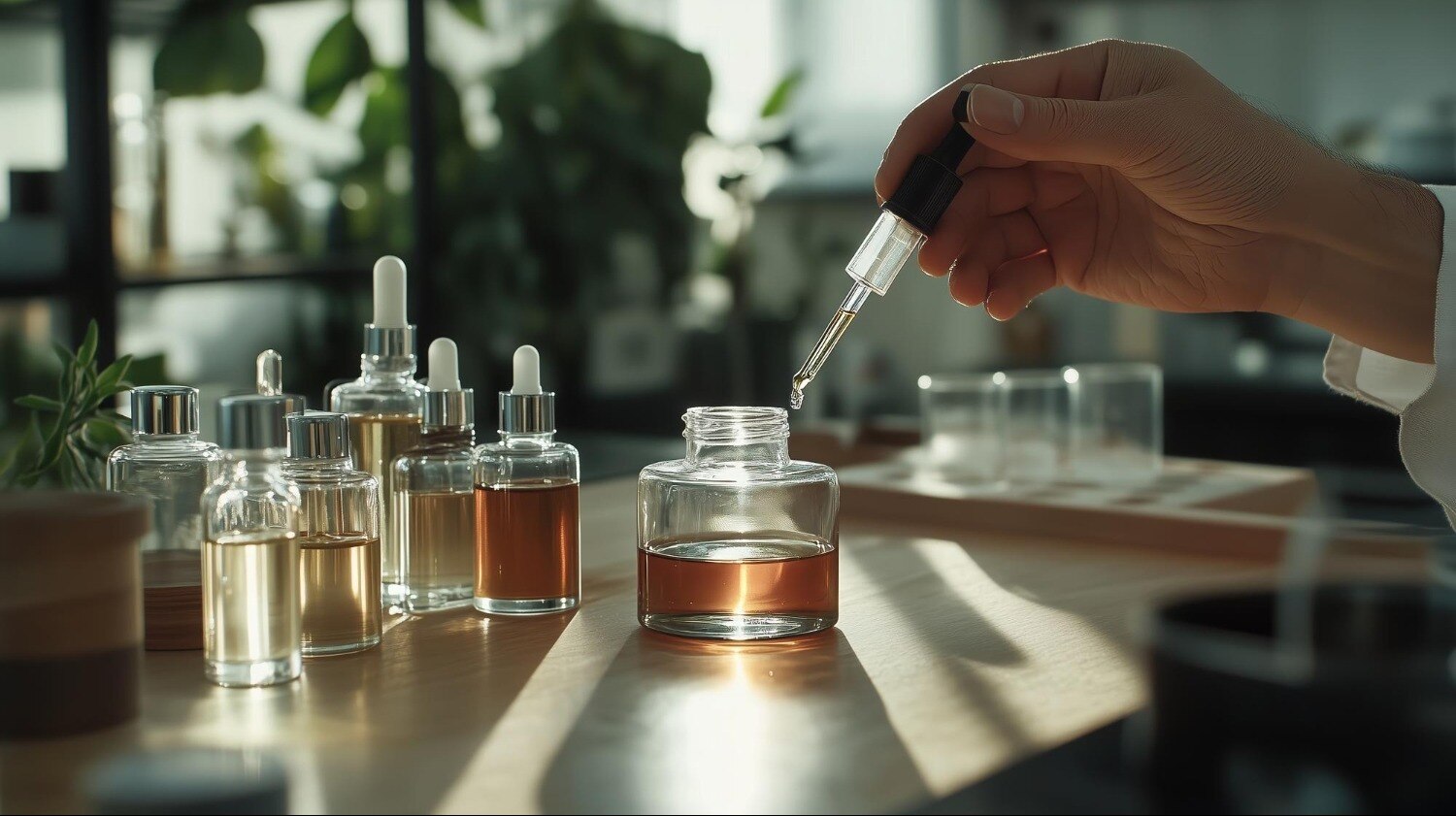
Use this workflow for a fragrance for attar:
- Set the fragrance-to-carrier ratio from the intended finished-product dosage, not from the concentrate’s odour strength alone.
- Weigh every material by mass; drops vary with temperature, viscosity, and dropper design.
- Add the fragrance slowly to the carrier in a documented order, then mix until uniform.
- Record the blending temperature and time. Keep both within the approved formulation range.
- Mature the mixture in a closed container for the defined period, allowing the odour and appearance to settle.
- Filter visible particles through a compatible filter, then fill into containers that resist oil uptake, staining, light, and seal failure.
This evidence, not the phrase “high quality fragrance for attar”, determines approval.
Which safety documents make an attar fragrance suitable for skin contact
Do not approve a fragrance for attar for skin contact from its marketing description. A fragrance for parfum, alcohol, detergent, incense, or air care is not automatically suitable for an oil-based cosmetic.
Check the compound against these documents and decisions:
- Intended-use assessment: confirm the finished product is a leave-on skin product, its application area, dosage, and carrier.
- IFRA certificate: verify the exact IFRA category and maximum use level for that finished application. A different dosage or product category can make the same compound non-conforming.
- Restricted-material review: identify prohibited or limited substances, including those controlled by the target market.
- Allergen declaration: calculate listed allergens in the finished attar formula, not only in the concentrate.
- Safety Data Sheet: use it for handling, hazards, storage, and transport; it is not a cosmetic safety assessment.
- Composition or restricted-substance statement: request enough information to screen regulatory limits.
- Contaminant information: ask about residual solvents, pesticides, heavy metals, and microbiological controls where relevant.
- Local-market documentation: confirm ingredient naming, notification, import, labelling, and responsible-person requirements.
For EU cosmetic labelling, listed fragrance allergens trigger disclosure above these finished-product thresholds:
| Product type | Threshold |
|---|---|
| Leave-on | 0.001% |
| Rinse-off | 0.01% |
Natural oils and extracts can contain allergens, vary by harvest, and oxidize in storage. Require batch-specific information and oxidation controls.
An IFRA certificate does not replace the EU cosmetic safety assessment or Product Information File. The responsible person still needs both before placing the finished product on the market.
How to test a high quality fragrance for attar before approving it
A high quality fragrance for attar must pass in the carrier and final pack, not only as a concentrate.
| Stage | What to assess | Pass evidence |
|---|---|---|
| Blotter | Opening, heart, dry-down, diffusion and residue | Profile matches the approved reference without harshness or new off-notes |
| Skin | Opening, heart, dry-down, tenacity and skin residue | No irritation in approved testing; odour remains recognisable at the defined wear-time |
| Finished formula | Dilution change, ageing, viscosity, colour and packaging interaction | No unacceptable odour shift, staining, leakage or loss of clarity |
Test the finished formula at the agreed dosage, such as 20% fragrance by mass in named jojoba oil. Check oil solubility, sediment, colour transfer and staining on skin-safe substrate, labels and fabric. Measure viscosity before and after ageing, and inspect for oxidation odour.
Write the stability protocol before approval: specify carrier, dosage, amber-glass or commercial packaging, fill level, temperatures of 5°C, 25°C and 40°C, light exposure, and a 12-week duration. Include three freeze–thaw cycles.
Pass appearance only with no visible sediment, phase separation or unacceptable colour change; pass odour only when the profile stays within the approved reference and develops no rancid or chemical note.
Replace “long lasting” with a retention test: assess skin at 0, 2, 4 and 8 hours, using a fixed application amount, and set a pass threshold such as median intensity of at least 2/5 at eight hours. Recheck the formula after ageing before placing the order.
What to request from a Colombo manufacturer before placing an attar order
“Top grade fragrance oil” is marketing language, not a regulated quality grade. For a high quality fragrance for attar, ask a Colombo manufacturer such as Khattri Aromas LLP for measurable specifications and acceptance limits before discussing price.
1. State the intended use, target market, and IFRA category. Name the carrier, finished-product dosage, sensory reference, colour limit, shelf-life target, prohibited materials, packaging, and required documents.
2. Request the odour profile, colour, specific gravity, refractive index, flash point, and defined stability results. Replace “long lasting” with a retention test stating dosage, carrier, temperature, package, and minimum wear time.
3. Require an SDS, IFRA certificate for the exact category and maximum use level, allergen declaration, composition or restricted-substance statement, contaminant information, certificate of analysis, shelf-life guidance, and local-market documents.
4. Require the batch number, raw-material traceability, manufacturing date, and retained-sample controls. Ask how natural materials are identified and how variation is managed; natural extracts need documented acceptance ranges.
5. Approve a reference sample in the final carrier and package, not only the concentrate. Each production batch must meet agreed sensory and instrumental tolerances against that sample, including odour, colour, specific gravity, refractive index, and appearance.
Reject a quotation that supplies only a perfume name and “premium” claim. The specification must also record the packaging material, fill size, seal, storage conditions, and action required if a batch falls outside tolerance.
Frequently asked questions
What does “fragrance for attar” mean?
It can mean a traditional hydro-distilled aromatic concentrate, a non-alcoholic perfume oil, a fragrance compound for dilution, or a finished oil ready for filling. Specify the format in your brief.
Which documents should you request for an attar fragrance used on skin?
Request an IFRA certificate for the intended product category, a Safety Data Sheet, an allergen declaration and a Certificate of Analysis for each batch.
How should you test a fragrance for attar before approval?
Evaluate the sample at its intended dosage in the proposed carrier, then check scent development, colour, clarity, skin feel, stability and packaging compatibility.
What should you ask a Colombo manufacturer before ordering attar fragrance?
Ask for the carrier, recommended dosage, sample specifications, minimum order quantity, lead time, batch documentation, storage conditions and change-control process.