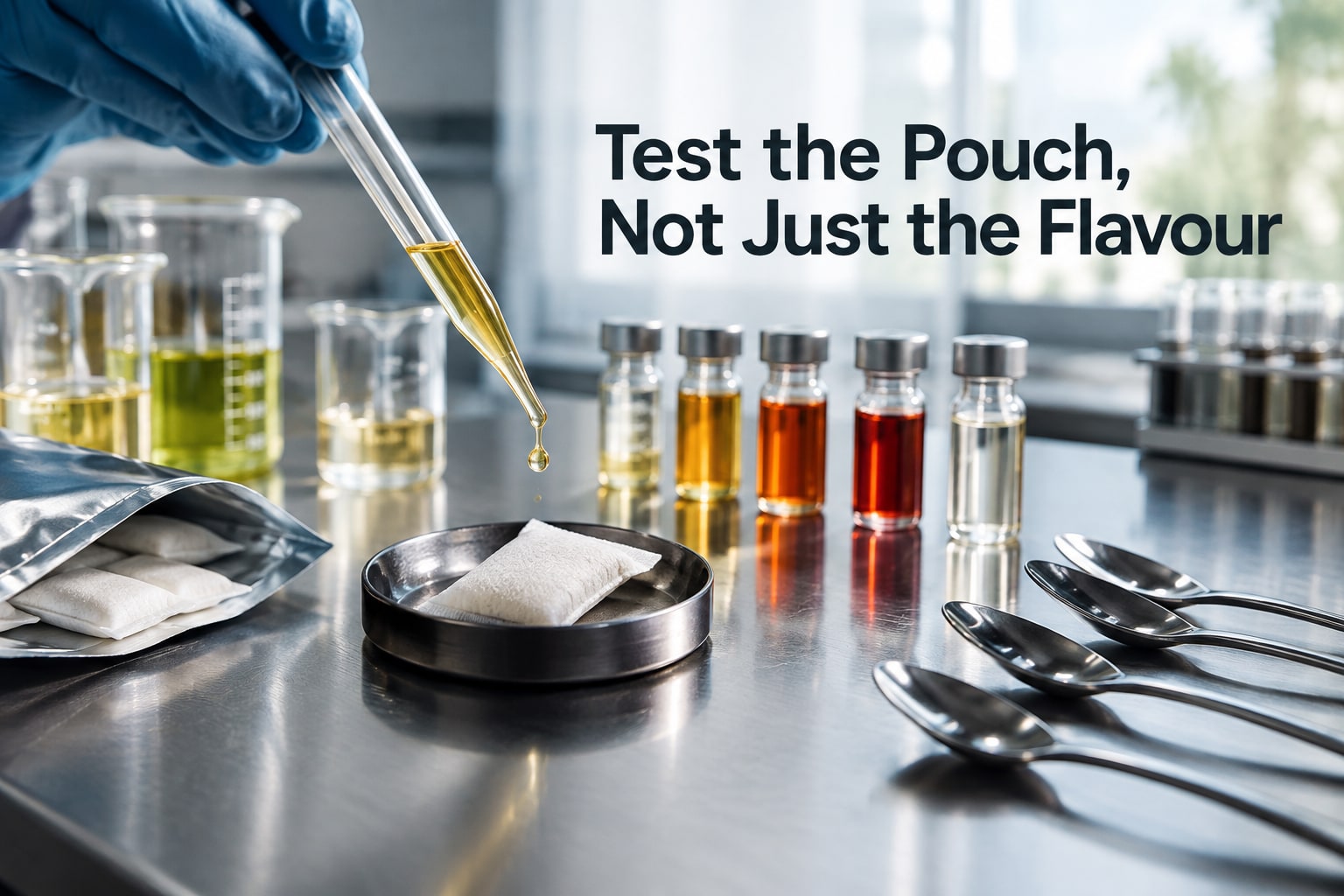
A flavour that smells strong in concentrate can disappear in a moist pouch, turn bitter at high pH, or lose its character during storage. By the end, you will know how to define quality, compare flavour systems, test them in a finished pouch, and assess a Jordan-based supplier’s technical evidence.
Key takeaways
- Judge flavour by onset, cooling, bitterness, aftertaste, and stability during pouch use.
- Match flavour format and manufacturing point to your pouch process.
- Compare samples at the same dosage, pouch material, nicotine level, and storage time.
- Request Jordan licensing, specifications, allergen data, and batch traceability before approval.
What makes a nicotine pouch flavour high quality?
A high-quality flavour has a clean onset, controlled intensity, balanced sweetness, acceptable cooling, low bitterness, no harsh chemical aftertaste, and a stable character throughout pouch use. These are sensory results, not claims such as “premium” or “long-lasting.”
Aroma before use and flavour after wetting are separate measurements: pouch material can retain or adsorb volatile compounds, while saliva, moisture, nicotine, and alkalinity change release after insertion.
| Stage | Record | Failure signal |
|---|---|---|
| Before use | Aroma strength, clarity, and any solvent or chemical note | Strong concentrate aroma that does not translate after wetting |
| First taste | Onset speed, sweetness, cooling, bitterness, and burn | Delayed release, sharp impact, or alkaline harshness |
| Development | Character and intensity during the first minute | Sweetness or cooling masking a weak or bitter body |
| Late use | Persistence, cooling duration, bitterness, and flavour balance | Flat, bitter, stale, or excessively medicinal finish |
| After removal | Residual flavour, irritation, and aftertaste | Chemical residue, prolonged burn, or unpleasant bitterness |
A single preference score hides these failures. For high quality flavours for nicotine pouches in Jordan, compare the finished pouch at each stage, using identical pouch weight, fabric, moisture, pH, nicotine strength, seal, and packaging.
Judge dosage in that finished pouch, not from the concentrate specification alone. Excess flavour can increase irritation, staining, bitterness, evaporation, or interaction with packaging; under-dosing can indicate poor release or storage loss rather than poor flavour quality. The pouch—not the bottle—is the product.
Which flavour families work, and how do snus flavours differ from pouch flavours?
Release and use experience vary by profile. Mint gives a familiar, quick lift; spearmint is softer and sweeter, while wintergreen is strong, rounded, and persistent. Menthol has a recognizable mint-cooling character, unlike WS-3, WS-23, and related cooling compounds, which can differ in onset, duration, and throat effect.
| Profile | Release and use experience | Common role |
|---|---|---|
| Mint | Fast, clean impact; can fade quickly | Top note |
| Menthol | Cooling with distinct mint character; can increase perceived sharpness | Top or body |
| Spearmint | Sweet, green, moderate persistence | Everyday profile |
| Wintergreen | Sweet, intense, long-lasting | Standalone or accent |
| Citrus | Bright, volatile, early release | Top note |
| Berry and fruit | Juicy opening; oxidation can flatten the finish | Top and body |
| Coffee | Roasted, bitter, slower and heavier | Body |
| Tobacco | Dry, earthy, persistent | Body and finish |
| Spice | Warm, distinctive, lingering | Accent or base |
| Confectionery | Sweet, creamy, or candy-like | Body and finish |
Traditional snus flavours cannot transfer directly to tobacco-free nicotine pouches. Snus commonly uses a tobacco-containing, paste-like matrix; pouches use plant fibres, nicotine, pH adjusters, sweeteners, humectants, binders, and flavourings. Nicotine form, pH, moisture, residence time, and pouch material alter release. Higher alkalinity increases free-base nicotine and perceived harshness.
Build layered systems: volatile mint, citrus, or fruit supplies the top note, while sweet, herbal, tobacco-style, or creamy notes support the body and finish. Judge every system at the target pH and in the finished pouch.
Which flavour format and manufacturing point should you choose?
Water-soluble liquids often disperse readily through moist fibre blends. Oil-based liquids and other hydrophobic materials can adsorb into cellulose or nonwoven pouch webs, slowing release and reducing delivered intensity.
| Format | Release behaviour | Best use |
|---|---|---|
| Water-soluble liquid | Fast dispersion in moisture | Moist, well-mixed fibre blends |
| Oil-based liquid | Slower release; fabric adsorption risk | Controlled release after web trials |
| Emulsion | Carries oil components through water | Mixed-polarity formulas |
| Encapsulated flavour | Delayed or protected release | Long residence time or shelf-life protection |
| Other carrier | Depends on polymer, powder or solvent | A defined release problem |
The supplier must recommend the format against your complete formula, not a generic confectionery or e-liquid base. Compare three addition points: blend into dry or moistened filler, apply to the substrate, or dose into a premix before pouch forming; each changes distribution, release and processing loss.
Check compatibility with:
- Cellulose or plant fibres, humectants and sweeteners
- Alkalising agents, nicotine salts or free nicotine
- Binders, preservatives and sealants
- Printing components and outer packaging
Run trials in the actual pouch web, seal configuration, moisture level, pH and packaging. Include fresh, accelerated-aged and real-time-aged pouches to identify evaporation, oxidation, adsorption or flavour loss. Traditional snus flavours cannot be assumed to work in a nicotine-pouch matrix; the finished pouch decides whether the format succeeds.
How should you test and compare supplier samples?
Run every supplier sample as a controlled side-by-side trial. Hold nicotine strength, pH, moisture, pouch weight, pouch fabric, seal, packaging, and use time constant; otherwise release differences can look like flavour quality.
| Stage | Record | Watch for |
|---|---|---|
| Aroma before use | Dry-pouch smell | Solvent, stale, or overly sharp notes |
| First minute | First taste, flavour development, cooling curve, sweetness, bitterness, burn or irritation | Strong impact followed by rapid fade |
| Mid-use | Persistence and balance | Cooling or sweetness masking bitterness |
| Late use | Character, duration, and aftertaste | Alkaline burn, chemical notes, or bitter finish |
Test all suppliers at the same dosage in the finished pouch. Then test a dosage range. A weak result can indicate under-dosing or poor release from the pouch, not poor flavour; excessive dosage can increase irritation, staining, bitterness, or packaging interaction.
Score each sample from 1 to 5 for sensory intensity, balance, colour impact, solubility or dispersion, batch consistency, and storage stability. Ask for the recommended dosage range in the finished pouch, not only the concentrate specification.
A flavour with high initial impact and rapid fade may need separate top, body, and base components, or an encapsulated delivery approach.
Use a record such as: Date: 23 September 2026; lot number: JN-024; formula code: PCH-M01; pH: 8.2; moisture: 18%; pouch material: nonwoven cellulose; dosage: 0.35%; evaluator comments: clean onset, cooling fades by minute four, mild late bitterness. This method helps identify high quality flavours for nicotine pouches in Jordan.
What should a Jordan supplier provide before approval?
Approval should follow a file-based decision, not a successful bench tasting. For every candidate flavour, require a technical dossier containing:
- Recommended dosage range in the finished pouch, not only in the concentrate; carrier information; and ingredient or component disclosure appropriate to the commercial agreement.
- Allergen statement; natural, nature-identical, or artificial classification; and the standard or jurisdiction used to define those terms.
- Regulatory-use statement, storage conditions, shelf-life or stability evidence, and batch traceability linking the sample to its lot.
- Certificate of analysis or certificate of conformity where applicable, including the tests covered and specification limits.
Food-use acceptance of an ingredient does not authorize a finished nicotine product, its nicotine source, claims, packaging, or importation in Jordan. Confirm each point against current Jordanian requirements before approval.
Require an Arabic-facing naming review before artwork or sales copy. “Ice,” “fresh,” “tobacco,” “energy,” “candy,” and “fruit” can carry different commercial or regulatory meanings, so keep the internal sensory code separate from the final name and claims.
A nicotine pouch flavour supplier in Jordan should run trials in your complete matrix, including fibre, nicotine form, pH, moisture, humectants, pouch web, seal, and packaging, while preserving consistent lot documentation.
Khattri Aromas LLP can be considered when the brief needs an application-specific flavour for that system; you remain responsible for finished-product validation and Jordan compliance.
Related product
 | Flavours Snus Flavours Snus and modern smokeless nicotine pouches represent one of the fastest-growing segments within the broader tobacco and nicotine products industry,... |
Frequently asked questions
What makes a nicotine pouch flavour high quality?
A high-quality flavour delivers a clean onset, controlled intensity, balanced sweetness, acceptable cooling, low bitterness, no harsh chemical aftertaste, and a stable character throughout pouch use.
Which flavour families work in nicotine pouches, and how do snus flavours differ?
Mint, menthol, fruit, citrus, coffee, tobacco, and botanical profiles can work when their intensity and cooling suit the pouch. Snus flavours often emphasise tobacco, bergamot, tea, smoke, and earthier notes, while nicotine pouch flavours use a broader range of clean mint, fruit, sweet, and cooling profiles.
Which flavour format and manufacturing point should you choose?
Choose a flavour format that matches your process, such as a liquid flavour for blending or a dry flavour for powder handling. Add it at the manufacturing point that delivers uniform distribution without damaging volatile top notes.
How should you test and compare nicotine pouch flavour samples?
Test samples at the same dosage, nicotine level, pouch material, fill weight, moisture level, and storage conditions. Compare onset, intensity, cooling, bitterness, aftertaste, and flavour stability at fixed time points.
What should a Jordan nicotine pouch flavour supplier provide before approval?
Request a product specification, recommended dosage, ingredient and allergen information, safety data sheet, certificate of analysis, shelf-life conditions, batch traceability, sample details, and the supplier's Jordan licensing documents.