
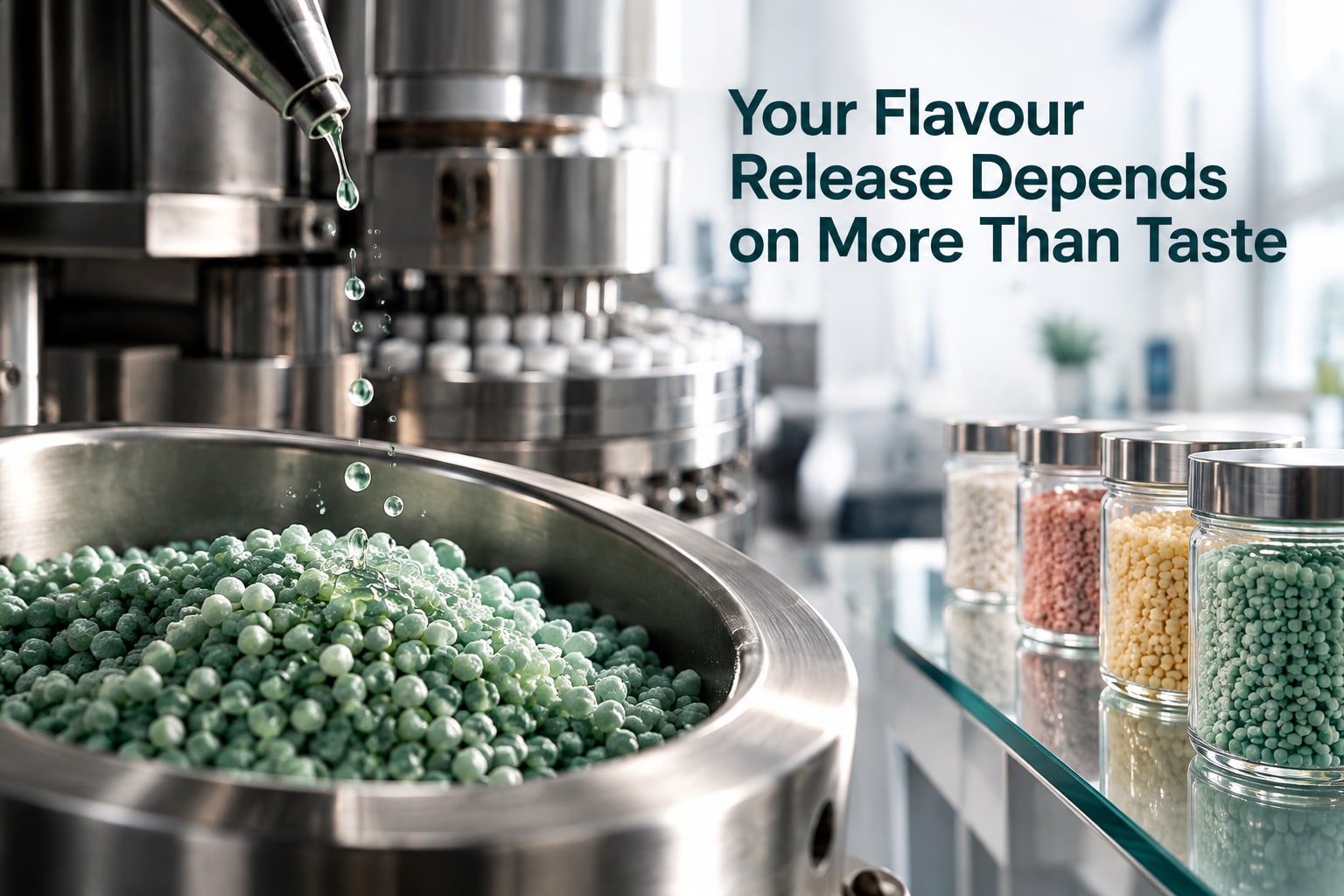
A mint, cardamom, fennel, or cooling note will not release the same way from a sugar-coated seed, compressed tablet, powder sachet, or liquid rinse. To specify the right solution, you need to connect the product’s texture, manufacturing process, flavour form, and intended sensory timeline before requesting samples or setting dosage.
Key takeaways
- Define crunch, chew time, dissolution, adhesion, and oil migration before flavour selection.
- Specify whether release must peak on first bite or during prolonged chewing.
- Match flavour form and release timing to coating, mixing, drying, and packing conditions.
- Compare bench samples, pilot batches, and shelf-life results before approving the formula.
Start with the Mouth-Freshener Format and Its Texture
To customize flavour solutions for mouth freshener texture and release in Kolkata, define the product format and texture before choosing a flavour. Specify coating thickness, crunch, chew time, dissolution time, powder adhesion, oil migration, and whether the first bite or prolonged chewing drives release.
| Format | Texture variables to record | Flavour implication |
|---|---|---|
| Coated fennel, mukhwas or pellets | Shell thickness, crunch, coating moisture, chew time | Use a flavour that penetrates or releases through the coating without softening it |
| Compressed tablet | Hardness, friability, porosity, disintegration time | Choose a flavour compatible with compression and controlled dissolution |
| Hard candy or lozenge | Glass clarity, hardness, melt time, saliva release | Match heat exposure and target a gradual mid-chew release |
| Powder sachet | Particle size, bulk density, flow, adhesion, caking risk | Select a dispersible flavour that does not segregate or clump |
| Chewable product | Elasticity, chew time, oil migration, residue | Balance strong first-bite impact with lasting freshness |
| Liquid rinse or spray | Viscosity, clarity, pH, mouth coating, dose volume | Confirm solubility and rapid, even flavour release |
Give the flavour developer the batch temperature, residence time, shear, order of addition, pH, water activity, drying method, coating composition, and flavour-addition temperature. A flavour added before cooling faces different losses from one added after cooling. Record the intended release curve: top note at contact, body during chewing, and residual freshness after swallowing.
Build a Complete Mouth Freshener Flavour Specification
A useful template for mouth freshener flavour specifications in Kolkata starts with the finished format, not the flavour name. State whether the application is coated fennel, sugar-coated pellets, a tablet, lozenge, powder, chewable product, or liquid rinse, because each matrix changes release and dosage.
Record these mouth freshener flavour development requirements:
- Target profile: mint, cardamom, fennel, menthol, botanical, or a defined blend, with acceptable and unacceptable notes.
- Flavour strength, application dosage range, sweetness balance, cooling intensity, bitterness masking, and colour impact.
- Permitted flavouring status, allergen declaration, carrier or solvent, solubility or dispersibility, and compatibility with oils, water, sugar, or polyols.
- Physical requirements: appearance, bulk density, particle-size range, coating compatibility, moisture sensitivity, and water-activity limit in the finished product.
- Process exposure: maximum temperature, mixing time, drying conditions, and whether the flavour contacts steam, alcohol, acid, or high-shear equipment.
- Release curve: top-note impact at first contact, peak during chewing or dissolution, cooling duration, and residual freshness after swallowing.
- Packaging format, shelf-life target, storage temperature, and acceptable changes in flavour, colour, texture, caking, or oil migration.
Request three comparison samples: an unencapsulated control, the proposed release system, and a deliberately stronger or weaker comparator. This separates matrix-driven release from simple concentration changes.
Run accelerated stability in the intended pack, checking key-marker assay, sensory profile, colour, texture, caking, and package condition for oxygen ingress, light exposure, seal leakage, or flavour migration.
Match Flavour Form and Release Timing to the Process
A liquid flavour gives fast surface impact, but it can evaporate during cooking or migrate through a dry coating. Choose powder for coated fennel, sugar-coated pellets, and sachets when you need easier dry blending, lower stickiness, and flavour held on the particle surface.
| Format | Best fit | Release role |
|---|---|---|
| Liquid | Rinses, sprays, post-cooling additions | Immediate first-bite or first-contact impact |
| Powder | Dry mukhwas, tablets, sachets | Rapid release with low process moisture |
| Oil-soluble | Fatty or oil-coated systems | Strong aroma and longer mid-chew persistence |
| Water-soluble | Syrups, rinses, water-based binders | Fast dissolution and clean, early release |
| Emulsion | Water-based products needing oil-note delivery | Disperses oil notes without visible separation |
| Encapsulated | Tablets, lozenges, coated pellets | Delayed mid-chew release and residual freshness |
Do not treat these labels as interchangeable. Oil-soluble flavour in a water-based rinse can separate; water-soluble flavour in an oily coating can release unevenly. An emulsion can solve dispersion, but its stabiliser and water load may soften a crisp shell.
Ask a custom mouth freshener flavour manufacturer for three matched samples: an unencapsulated control, the proposed release system, and a stronger or weaker comparator. Test them in the finished matrix, not in water alone. Record time to first perception, time to peak intensity, duration through chewing, and residual after swallowing.
Use time-intensity sensory testing alongside headspace or GC-MS data. Instrumental retention shows what remains; it does not prove what the consumer perceives after saliva, chewing, and dilution.
Control Manufacturing Variables That Change Release
Batch temperature, residence time, shear, and order of addition can change both flavour retention and mouth-freshener texture. Adding a volatile flavour before cooling can strip top notes; adding it after coating can produce uneven release. To customize flavour solutions for mouth-freshener texture and release in Kolkata, record these conditions before approving a concentrate:
- Match the flavour to the format: coated fennel, sugar-coated pellets, tablet, lozenge, powder, chewable product, or liquid rinse.
- Record pH, water activity, drying method, coating composition, and whether the flavour enters before or after cooling.
- Measure finished-product moisture and water activity rather than inferring them from the incoming flavour.
- Check flavour profile, key-marker assay, colour, caking, crunch, shell tackiness, oil migration, and package condition during storage.
| Variable | What changes | Control point |
|---|---|---|
| Batch heat and residence time | Volatile loss and weaker first-bite release | Set a maximum product temperature and hold time |
| Shear and mixing order | Uneven distribution, broken particles, or altered coating | Define mixer speed, addition sequence, and mixing duration |
| Humidity and water activity | Caking, soft shells, flavour migration, and faster degradation | Use moisture-barrier packaging and a finished-product limit |
| Oxygen, light, and seal integrity | Oxidation or flavour loss during storage | Run accelerated stability in the intended pack |
| Drying conditions | Porosity, crunch, and release speed | Record inlet and outlet temperatures and drying time |
A stronger control sample and a release-system sample help separate concentration effects from process-driven release differences.
Validate the Formula from Bench Sample to Shelf-Life Trial
Approve a custom flavour only after it survives the finished mouth freshener, the process, and the intended pack. A flavour that smells excellent in a bottle can disappear during coating, turn harsh after compression, or lose crunch when moisture enters.
Ask the custom mouth freshener flavour manufacturer for three matched samples:
- An unencapsulated control
- The proposed release system
- A deliberately stronger or weaker comparator
Test all three at a validated finished-product dosage range, not at a universal percentage. Compare first-bite impact, mid-chew release, residual freshness, bitterness, burning, menthol harshness, and flavour retention after processing. Record batch temperature, residence time, shear, order of addition, pH, water activity, coating composition, drying method, and whether flavour is added before or after cooling.
Your mouth freshener flavour development requirements should include a pilot batch in the production process, followed by testing in the final packaging. Measure flavour profile, key-marker assay, colour, texture, caking, shell tackiness, and package condition.
Check finished-product moisture content and water activity; incoming flavour data cannot predict humidity damage in sugar, polyol, salt, acid, or botanical matrices.
For mouth freshener flavour specifications in Kolkata, request an accelerated shelf-life plan using the intended pack. It must examine oxygen transmission, light exposure, seal leakage, polymer or coating migration, and flavour loss at defined intervals. Khattri Aromas LLP can use these process details to separate a formulation problem from a manufacturing or packaging failure.
Related product
 | Flavours Mouth fresheners Flavour Khattri Flavours specializes in developing customized mouth freshener flavour solutions designed specifically for manufacturers of mouth fresheners,... |
Frequently asked questions
What texture details belong in a mouth freshener flavour specification?
Record the format, coating thickness, crunch, chew time, dissolution time, powder adhesion, oil migration, and the point when flavour release should peak.
How do you match flavour form to mouth freshener processing?
Choose the flavour form and release profile around the product’s mixing, coating, drying, and packing steps so heat, moisture, and abrasion do not release it too early.
Which manufacturing variables can change mouth freshener release?
Control ingredient addition order, mixing intensity, drying conditions, coating thickness, residual moisture, storage temperature, and pack exposure because each can alter release.
How should a custom mouth freshener flavour be validated?
Compare bench samples with pilot batches, measure texture and release at defined intervals, then confirm sensory performance through shelf-life trials.