
A fragrance that smells promising in a bottle can haze a liquid detergent, cake inside a powder, or disappear before the wash is finished. You will be able to brief manufacturers, test samples in your own formula, verify documentation, and compare Colombo suppliers on evidence rather than scent alone.
Key takeaways
- Give the manufacturer your detergent formula, process, packaging, and target dosage.
- Confirm the supplier manufactures fragrances rather than only trading finished compounds.
- Test fragrance performance in the finished detergent and after washing.
- Request stability data covering manufacture, storage, and 72-hour fabric retention.
Define the detergent system before asking for a fragrance
Give the manufacturer the detergent system, not just a blotter or a preferred scent name. A custom detergent fragrance designed for liquid laundry detergent can fail in powder detergent because surfactants, builders, enzymes, bleaches, solvents, moisture, heat, and processing conditions change its behaviour.
1. State the application and dosage target: liquid detergent or powder detergent, fragrance concentration in the finished product, acceptable dosage range, batch size, and whether the product is concentrated, diluted, spray-dried, or agglomerated.
2. Describe the fragrance brief: fresh, floral, citrus, woody, or another defined character; colour limit; odour strength; raw materials to exclude; and any restrictions from the finished product, such as chlorine bleach, optical brighteners, enzymes, or sensitive packaging.
3. Provide processing and storage conditions, including mixing temperature, residence time, powder-processing temperature, water activity or moisture target, container type, headspace, and expected shelf life. A powder detergent fragrance can smell strong at filling yet lose performance after volatile materials migrate, evaporate, react with alkaline builders, or release from the carrier.
4. Agree on the performance test before sampling: dosage ladder, pilot-batch formula, wash-cycle method, fabric types, evaluation points, acceptance panel, and benchmark product. Test neat fragrance only for screening, not approval.
5. Request the documentation package: SDS, IFRA Certificate of Conformity for the specific laundry product category and maximum fragrance concentration, allergen information, specification, retain-sample policy, and written change-notification terms. An SDS or IFRA certificate alone proves neither detergent compatibility nor fabric performance.
Separate fragrance-manufacturing capability from a trading claim
Ask for evidence of compounding, not a catalogue of aroma materials. “Detergent fragrance manufacturer in Colombo” identifies a location, not a capability. A liquid flavour manufacturer is not automatically qualified: flavours are designed for ingestion, while detergent fragrances must survive surfactants, builders, enzymes, heat, moisture, skin contact, and fabric deposition.
| Evidence | What it proves | Warning sign |
|---|---|---|
| Batch manufacturing record | Raw-material weights, order of addition, mixing time, temperature, and batch number are controlled | Only a supplier invoice or product catalogue |
| In-house quality record | Each batch receives checks such as odour comparison, appearance, density, and identity testing | A generic certificate covers every batch |
| Retain-sample system | The approved fragrance can be compared with later production | No retained sample or traceable reference standard |
| Production visit or live video | Weighing, compounding, filtration, filling, and labelled storage occur at the claimed site | Finished drums arrive from an undisclosed location |
Request these before approving a sample:
- The formulation or batch record showing whether the fragrance is compounded locally or merely repacked.
- The certificate of analysis, safety data sheet, allergen declaration, and fragrance-standard documentation for the exact batch.
- The approved reference sample, retain-sample period, and written odour-acceptance procedure.
- The name and location of raw-material storage, finished-goods storage, testing, and technical support.
Ask how the fragrance is added to liquid and powder detergent. A supplier that understands volatile loss during heating, drying, or high-shear mixing should explain the chosen addition point and its uniformity controls. Finally, request a scale-up batch: matching a laboratory sample after production is stronger proof than a persuasive sales claim.
Test the fragrance in the finished detergent, not on a blotter
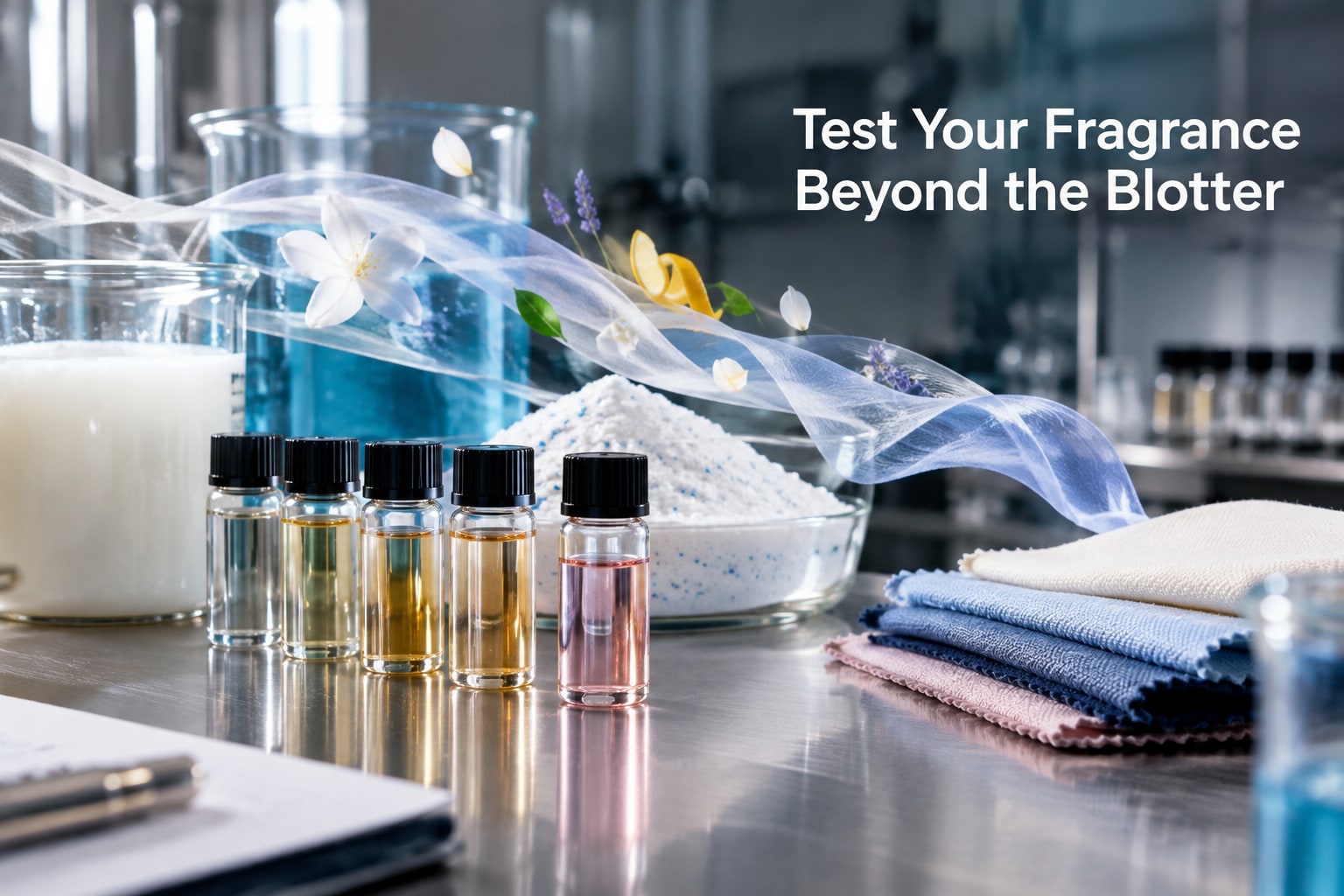
A blotter can pass while the finished detergent turns hazy, separates, discolours, or loses its scent. Test the fragrance in the product base because surfactants, builders, enzymes, bleaches, solvents, and alkaline salts can change both stability and odour.
Prepare pilot batches of the actual liquid or powder detergent, using the intended raw materials and processing conditions. Include an unscented base, a current benchmark, and the custom detergent fragrance at 0.5, 1.0, and 1.5 times the target dosage. Keep each batch size, mixing time, temperature, and fragrance-addition point recorded.
Run the detergent through the intended machine cycle with standardised fabric swatches and water hardness. Record these observations at each stage:
- Liquid detergent: clarity, haze, separation, colour, viscosity, headspace odour, and fragrance strength after storage.
- Powder detergent: flowability, moisture pickup, caking, dusting, fragrance loss, and odour uniformity after mixing and storage.
- Wash liquor: odour during dosing, agitation, rinsing, and machine unloading.
- Fabric: scent immediately after washing, after drying, and after 24, 48, and 72 hours in controlled conditions.
Use the same fabric type, detergent dose, wash temperature, load weight, drying method, and evaluation panel for every sample. A fragrance that smells strong in the bottle but disappears after drying fails the practical test; one that survives washing but causes haze, caking, or unacceptable colour fails the formulation test.
Request the test method, panel scores, batch records, and IFRA Certificate of Conformity for the intended detergent use level.
Measure stability from manufacture through 72 hours on fabric
A stable liquid detergent fragrance remains uniformly dispersed, keeps the intended colour and viscosity, and leaves no oil ring, sediment, gel, or abnormal headspace odour. A stable powder detergent fragrance remains free-flowing, dry, and evenly scented without caking, premature odour loss, or alkaline degradation.
| Checkpoint | Liquid detergent fragrance | Powder detergent fragrance |
|---|---|---|
| Manufacture and processing | Confirm solubility or emulsion stability after mixing, plus colour, viscosity, and odour in the headspace. | Check uniform distribution, flowability, moisture pickup, caking, and odour after blending or spray-drying exposure. |
| Storage | Inspect for separation, sediment, viscosity drift, colour change, and a sour, solvent-like, or stale odour. | Inspect sealed samples for clumps, dampness, volatile loss, carrier failure, and odour migration into the pack. |
| Washing | Record odour before dilution, in the wash liquor, and during rinsing; watch for excessive foam or fragrance stripping. | Record release in the wash liquor and rinse, because strong initial powder odour can hide poor release after storage. |
| Fabric | Compare wet fabric, immediately dried fabric, and fabric at 24 and 72 hours against a retained benchmark. | Compare the same stages, checking whether the powder detergent fragrance deposits evenly and remains recognisable at 72 hours. |
Test matched pilot batches at the intended dosage and after defined storage, not only neat fragrance. Keep temperature, humidity, detergent base, wash load, water hardness, and drying method fixed; otherwise a failed comparison may reflect the test rather than the fragrance. Record panel scores and physical observations beside each batch and lot number.
Compare Colombo suppliers on evidence, supply security, and terms
After technical testing, choose the detergent fragrance supplier in Colombo that can reproduce the approved result under real supply conditions, not the one with the strongest first sample. Ask where compounding, quality testing, raw-material storage, finished-fragrance storage, retained samples, and technical support are located.
A “manufacturer” label proves nothing if the company only blends or repacks imported material.
- Request a batch-specific certificate of analysis, lot number, manufacturing date, storage instructions, and retained-sample procedure. Use refractive index and specific gravity as identity checks, not as proof of detergent performance.
- Set written limits for shelf life, transport temperature, maximum shipment duration, and protection from heat, humidity, light, and oxygen. Confirm that the container does not swell, leak, soften, or absorb fragrance.
- Ask how the supplier controls batch-to-batch odour, reproduces the approved formula after scale-up, handles imported key materials, and maintains backup production.
- Treat liquid-flavour experience as separate evidence. Fragrance for detergent must withstand surfactants, builders, enzymes, bleaches, solvents, washing, and fabric contact.
| Supplier evidence | Supply security | Commercial terms |
|---|---|---|
| Local compounding and test records | Backup production and imported-material plan | Minimum order quantity and lead time |
| Batch traceability and retained sample | Shelf life and shipment controls | Price validity, payment, and delivery responsibility |
| Approved formula reproduced at scale | Packaging compatibility in tropical transport | Replacement terms for failed or off-spec batches |
Khattri Aromas LLP belongs in the comparison only after it answers these same questions and supplies records that let you verify them. A lower price is not a saving if a delayed shipment, unstable pack, or unreproducible batch forces a reformulation.
Related products
 | Fragrances Detergents Fragrances Premium Detergent Fragrance Solutions for Cleaning Product Manufacturers, In the detergent industry, fragrance is more than just a pleasant scent—it... |
 | Fragrances Household products Fragrances Household Product Fragrance Manufacturers| Customized Fragrance Solutions for Household Product Brands, Innovative Fragrance Solutions for Household... |
Frequently asked questions
What information should you give a detergent fragrance manufacturer?
Provide the detergent form, surfactants, builders, enzymes, bleaches, solvents, moisture level, processing temperature, packaging, target dosage, and storage conditions.
How can you tell whether a fragrance supplier is a manufacturer or a trader?
Ask for evidence of in-house formulation and production, including a manufacturing site, batch records, quality specifications, retained samples, and technical support.
Why must fragrance be tested in finished liquid and powder detergent?
Surfactants, builders, enzymes, bleaches, moisture, heat, and processing conditions can change fragrance strength, colour, compatibility, and stability.
How should detergent fragrance stability be measured?
Test samples from manufacture through storage and evaluate fragrance during use, including scent on fabric immediately after washing and up to 72 hours later.
How should you compare a detergent fragrance supplier in Colombo?
Compare formulation evidence, finished-product test data, lead times, minimum order quantities, batch consistency, documentation, backup supply, payment terms, and complaint handling.
Related product
 | Fragrances Customized Home Care Fragrances for Modern Cleaning and Hygiene Products, The home care industry has evolved beyond basic cleaning products, with... View product → |