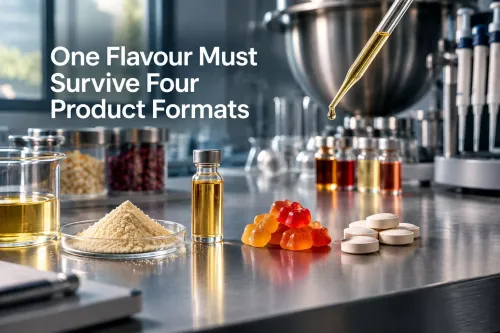

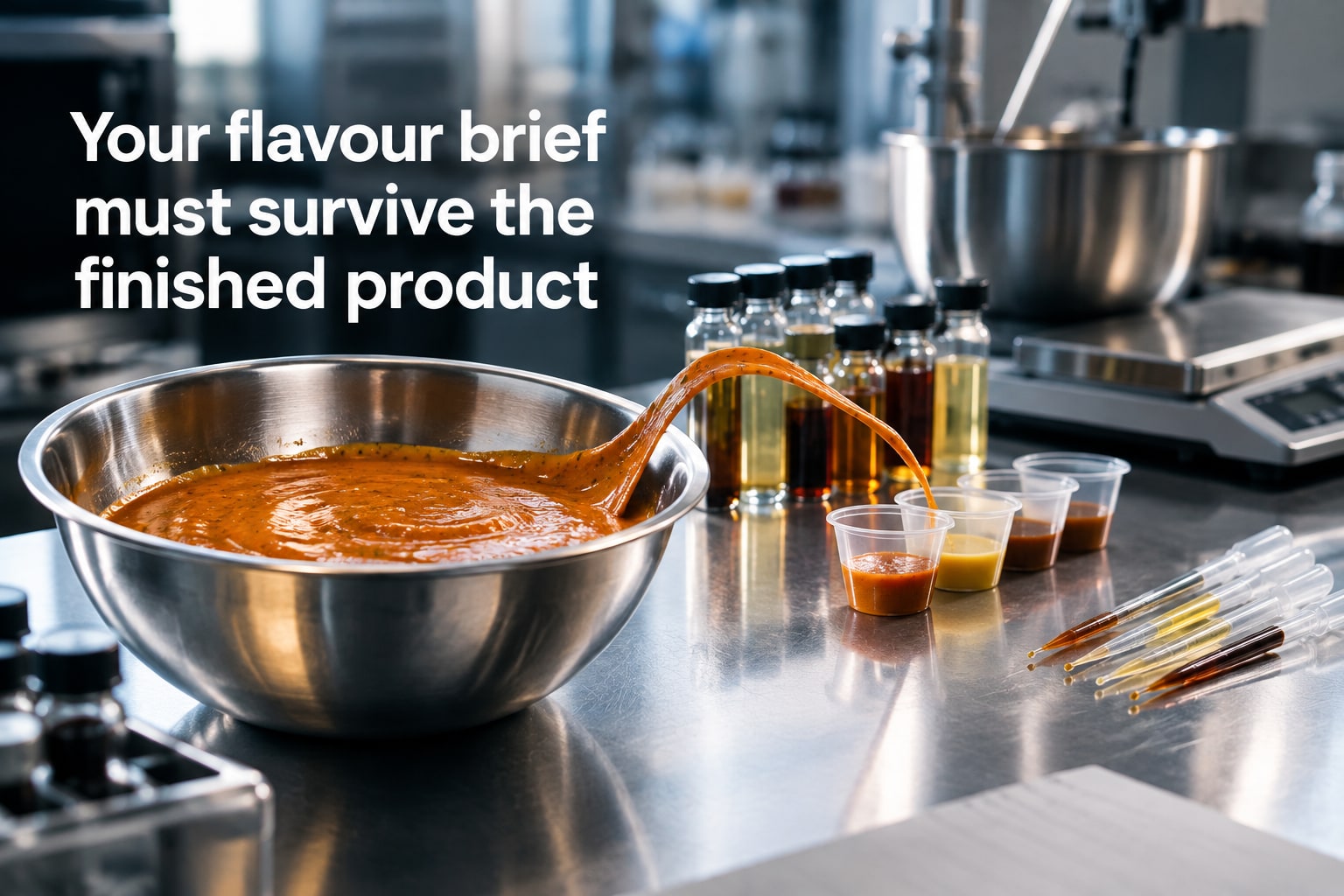
A savoury flavour that smells right on a strip can fail after frying, extrusion, retort or high-shear mixing. The right brief, finished-product trial and approval gates turn a vague target such as “roasted chicken” into a repeatable commercial batch with known dosage, documentation and shelf-life performance.
Key takeaways
- Start with the finished food, recipe, process and packaging conditions.
- Choose liquid, dry, heat-stable or encapsulated flavour for the application.
- Test prototypes across a dose ladder in the finished product.
- Approve flavour against sensory performance, cost, shelf life and batch documents.
Build a flavour brief from the finished food, not a flavour description
A useful custom savoury food flavour starts with the finished food, not “roasted chicken” or another sensory description. To customize flavour for b2b savoury food production, submit the product matrix and recipe context first.
1. Identify the application: chips, extruded snacks, sauce, soup, instant noodles, meat alternative or ready meal. State fat and water levels, pH, water activity, salt, sugar and umami ingredients, plus the current seasoning or flavour system.
2. Specify the manufacturing conditions: target dosage in the finished food, addition point, mixing sequence, equipment, batch size, processing temperature and time. State whether the product is fried, baked, extruded, retorted, pasteurised, dried or frozen.
3. Add packaging material, headspace, intended shelf life, target cost per finished kilogram, regulatory market and a reference sample. Identify whether you need a top note, cooked character, roast note, mask or modifier.
The manufacturer converts this information into a flavour brief containing defined sensory attributes, a dosage range, carrier requirements, documentation needs and acceptance criteria. A flavour tested only in water can fail after frying, extrusion or retorting.
Include allergen and cross-contact requirements from the start. Soy, wheat, milk, celery, mustard and sesame can affect the label at low use levels, whether present in the formula or manufacturing environment. This information makes a custom savoury food flavour testable, documentable and suitable for scale-up.
Choose the flavour type that matches the application and process
Choose the flavour format by the sensory job and the food process. A top-note flavour delivers fresh onion, herb, spice or roasted aroma quickly, but heating strips volatile notes. A process flavour develops deeper roasted, grilled, meaty or browned character during extrusion, baking, frying or cooking.
A reaction flavour requires controlled precursor records and heat records. For EU-market products, Regulation (EC) No 1334/2008 Annex V sets a maximum temperature of 180 °C and defined time-temperature combinations. Use a mask to reduce soy, mineral, bitter, oxidised or processing notes; use a modifier to reshape an existing profile without replacing it.
| Format | Sensory or physical function | Suitable application |
|---|---|---|
| Seasoning blend | Dry flavour and seasoning delivery | Chips and extruded snacks |
| Water-soluble liquid | Dispersion through the aqueous phase | Soups and water-based sauces |
| Oil-soluble liquid | Retention in fat | Fried coatings, oils and fat-rich foods |
| Emulsion | Disperses oil components through water | Sauces, soups and marinades |
| Spray-dried powder | Dry, free-flowing flavour delivery | Dry seasoning systems |
| Encapsulated flavour | Protects volatile notes during storage or processing | Heat-exposed dry or cooked foods |
A liquid flavour manufacturer serving savoury food should test the carrier in your actual equipment and order of addition. Check alcohol, oil, water and high-shear compatibility; poor selection causes clouding, ring formation, phase separation or uneven dosing.
A custom savoury food flavour that works in a dry seasoning can fail in retort, extrusion or an aqueous sauce.
Test every prototype in the finished product through a dose ladder
Judge a custom savoury food flavour in the finished food, not on a smelling strip or water dilution. Prepare a retained control plus under-dose, target-dose and over-dose trials using the same recipe, batch size, ingredients, equipment, order of addition, mixing time and process conditions. Record exact grams of flavour per finished kilogram.
Evaluate every sample before processing and after the customer’s actual process: frying, baking, extrusion, retort, pasteurisation, drying or high-shear mixing. Record:
- Aroma, taste, roast or cooked character, mouth impact, aftertaste, heat stability, flavour release and off-notes.
- Changes caused by the food matrix, including lost top notes and added cooked, sulphurous, smoky or burnt character.
Use the test that matches the decision.
| Method | Question answered | Use |
|---|---|---|
| Triangle test | Can tasters distinguish two samples? | Product comparison |
| Descriptive profile | Which attributes changed, and by how much? | Approval of chicken, onion, sulphury, burnt, smoky or lingering notes |
ISO 13299 provides a framework for descriptive sensory profiling. Keep the control throughout the trial; greater intensity is not the same as improvement.
To customize flavour for B2B savoury food production, reproduce the commercial process rather than relying on a laboratory blend. The addition point, vessel geometry, shear, evaporation and heat transfer can change dispersion and volatile retention, so the approval sample must come from a representative processed batch.
A dose ladder that survives this test gives the custom savoury food flavour a defensible route from brief to batch.
Set dosage against performance, cost and shelf life
Set the dose in the finished food, not in a neat flavour sample. Run an under-dose, target dose and over-dose, recording grams per finished kilogram, then change one variable at a time.
If the first trial is weak, increase the dose only after checking dispersion, process losses and the addition point; if it is too strong, reduce the dose before changing the flavour system.
A higher dose can lift aroma and cooked character, but it also increases cost per finished kilogram and can reveal bitter, solvent, sulphur, smoky or artificial off-notes. Lowering sodium does not make extra flavour a substitute for salt, monosodium glutamate, yeast extract or hydrolysed protein; these ingredients alter taste balance, so request a revised brief.
A savoury food flavour supplier should assess the complete taste system.
For an unstable liquid, test the supplied container and the final food where possible. Ask a liquid flavour manufacturer with savoury food application experience to challenge:
- Oxidation, evaporation, sedimentation, phase separation and package interaction.
- Garlic, onion, meat and smoke profiles against oxygen, heat and headspace; sulphur-containing notes can shift during storage.
- Appearance, odour, density or refractive index, solubility, carrier identity, water activity, marker compounds and microbiological limits where relevant.
Use GC-MS to support identity or adulteration checks, not to approve performance alone. Finished-food sensory results remain decisive, because a flavour can pass neat testing yet fail after heating, storage or mixing.
Pass the commercial approval gates before releasing the batch
Release a repeat-supply batch only after the finished food passes every technical, regulatory and commercial gate. Approve the final sensory profile, dose, application method, process window, packaging and shelf-life result before signing the specification.
- Confirm the specification, including appearance, odour, density or refractive index, solubility, water activity where relevant and microbiological limits.
- Set the certificate of analysis fields, carrier identity, allergen and cross-contact statement, regulatory route and label wording for every target market.
- Record the development quantity, minimum order quantity, production batch size, raw-material availability and repeat-order lead time.
- Agree change-control notification and the reapproval threshold for raw materials, extracts, carriers, suppliers, manufacturing site and process.
“Natural” is not a universal claim. Use the market-specific route below.
| Market | Reference | Approval question |
|---|---|---|
| United States | 21 CFR 101.22 | Does the formula and label wording support “natural flavor” treatment? |
| European Union | Regulation (EC) No 1334/2008 | Does the flavour category and label name comply? |
| Allergens | Regulation (EU) No 1169/2011 or applicable US rules | Do formula ingredients and factory cross-contact require declaration? |
Reproduce the customer’s addition point, vessel geometry, shear, mixing time, heat transfer and evaporation conditions in scale-up. Take the approval sample from a representative production batch, not a laboratory blend.
A savoury food flavour supplier that cannot document repeatability, supply terms or changes is not ready for repeat supply. Khattri Aromas LLP should be evaluated against these same gates, using pilot evidence, batch documents and agreed commercial quantities.
Related product
 | Flavours The savoury food and snacks category is one of the largest and most dynamic segments of the global packaged food industry, encompassing everything... View product → |
Frequently asked questions
What information belongs in a savoury flavour brief?
Provide the finished food, ingredient list, target sensory profile, processing temperatures and times, dosage limits, packaging, shelf life and regulatory requirements.
How do you choose the right flavour type for savoury food production?
Match the flavour format to the recipe and process. Check whether the application needs a liquid, dry, heat-stable, oil-soluble or encapsulated flavour.
Why test a flavour through a dose ladder?
A dose ladder shows the point where flavour becomes noticeable, balanced, excessive or uneconomical in the finished product.
What should commercial approval cover before releasing a batch?
Confirm sensory performance, dosage, cost per finished unit, shelf-life results, specification, batch number, certificate of analysis and production consistency.