
Choosing a wellness flavour supplier involves more than comparing berry, citrus or vanilla samples. You need to match the supplier’s development method, documentation, minimum order, processing capability and technical support to the active ingredients and finished product format. By the end, you can compare suppliers, decide between a ready-made and custom flavour, and run a meaningful approval process.
Key takeaways
- Match the flavour to the finished product, dosage form and processing conditions.
- Choose ready-made flavours for speed; choose custom flavours for specific sensory or formulation problems.
- Ask Johannesburg manufacturers for ingestion-use documentation, samples and batch traceability.
- Test flavours in the final powder, liquid, gummy or tablet—not only in water.
What Does Custom Wellness Flavour Manufacturing Actually Change?
A custom wellness flavour is built around the finished product, not selected from a catalogue by profile name alone. It must be a flavouring preparation intended for ingestion; an external-use fragrance is a different material.
IFRA Standards address fragrance safety uses and do not establish that a fragrance is suitable for food, supplements or oral wellness products.
| Option | What you receive | Main limitation |
|---|---|---|
| Standard flavour listing | An existing profile such as lemon, berry or vanilla | It may clash with minerals, botanicals, proteins or acids |
| Ingredient distributor | A flavour or ingredient supplied from a producer’s range | Technical adaptation and finished-formula testing may be limited |
| Custom developer or compounder | A flavour system adjusted or created for your product | It requires more samples, testing, documentation and lead time |
Ask customize flavour manufacturing companies what they can actually change:
- Flavour direction and intensity
- Bitter or metallic-note masking
- Sweetness perception and aftertaste
- Carrier system, colour, format and dosage
- Resistance to heat, oxygen, light and pH changes
A custom brief does not make a health claim legal. In South Africa, changing a flavour name to “immune defence” or “detox” cannot fix a misleading food label or an impermissible therapeutic claim; the brand owner must confirm the product category and permitted claims.
Approve custom wellness flavours in the complete formula, before and after processing, then at defined stability checkpoints. Citrus and mint top notes can fade, while oxidation-sensitive actives can create stale or aldehydic notes that a neat sample will not reveal.
Ready-Made or Custom: Which Route Fits Your Wellness Product?
A ready-made wellness flavour saves development effort when your base is stable, the sensory target is familiar, and the product does not contain difficult actives. Existing samples shorten bench work, but approval still belongs in the complete formula at the proposed dosage.
| Route | Development effort | Best fit |
|---|---|---|
| Ready-made wellness flavours | Fewer sample rounds and faster initial screening | Straightforward powders, drinks or gummies with manageable bitterness |
| Custom wellness flavours | More briefs, prototypes and technical testing | Products with botanicals, minerals, proteins, acids, oils or high-intensity sweeteners |
| Modified ready-made flavour | Moderate testing with targeted adjustment | A near-match exists but needs better masking, sweetness balance or aftertaste control |
Custom formulation justifies the extra work when the active ingredient suppresses top notes, increases bitterness, or creates a lingering off-note after processing. It also makes sense when you need a distinctive sensory profile, must survive pasteurisation, high shear or extrusion, or need performance at a tight dosage or cost.
Give the manufacturer more than “berry” or “natural vanilla”. Specify the finished matrix, pH, water activity, processing temperature, target dosage, packaging, shelf life, allergen limits and target cost. Ask for blind samples in the finished base, plus a retained reference sample for later batch comparison.
Do not choose custom wellness flavours solely for novelty. If a ready-made option performs cleanly after processing, meets documentation and supply requirements, and fits your launch volume, custom work adds time without solving a real problem. If minimum orders exceed your forecast, request pilot quantities before approving either route.
How to Compare Flavour Manufacturers in Johannesburg
Do not compare a flavouring preparation with an external-use fragrance. A supplier citing IFRA Standards has not shown that its material is suitable for ingestion. Ask for food or oral-use documentation, carrier details, recommended dosage, allergen status, and evidence from the finished wellness formula.
For each of the customize flavour manufacturing companies for wellness in Johannesburg, request the same comparison pack:
- A neat sample and a sample dosed into your actual base
- Testing before and after heating, drying, mixing, or tableting
- Stability checkpoints in the final package, including flavour, colour, and off-notes
- Minimum order quantity, pilot-batch availability, sample lead time, production lead time, and reorder lead time
- Batch records, retained reference samples, specification limits, and a stated reformulation policy
- Confirmation of what can change: flavour direction, masking, sweetness perception, carrier, colour, format, dosage, and processing resistance
| Comparison point | Custom developer | Compounder or distributor | Ready-made flavour supplier |
|---|---|---|---|
| Best fit | Difficult botanicals, minerals, proteins, or strong aftertaste | Defined brief needing technical adjustment | Fast launch with a compatible base |
| Main risk | Longer development and validation | Limited differentiation or masking | Poor release at final dosage |
| Commercial check | Pilot quantity and ownership terms | Minimum order and stock continuity | Reorder consistency and available pack sizes |
A wellness flavour manufacturer in Johannesburg should explain how it controls volatile loss, oxidation, and batch-to-batch sensory drift. Khattri Aromas LLP belongs in the comparison when its team can show those controls in samples made for your actual process, not only in a neat vial.
Related product
 | Flavours Wellness Flavours The global wellness industry has experienced extraordinary growth over the past decade, as consumers increasingly seek functional foods, herbal... |
How Should You Develop and Test a Wellness Flavour?
A flavour works only when it survives the finished wellness formula. Protein, fibre, minerals, botanical extracts, acids, oils and high-intensity sweeteners can suppress top notes, intensify bitterness or leave a persistent off-note that a neat sample never reveals.
Use this development workflow:
1. Write the brief against the final matrix: format, active ingredients, target dosage, pH, water activity, packaging, shelf life, allergen limits, permitted claim language and target cost. State whether the flavour must withstand pasteurisation, high shear, heat or extrusion.
2. Ask for custom wellness flavours matched to the base, not a descriptive name such as “berry”. Confirm what changes: flavour direction, masking, sweetness perception, carrier system, colour, dosage and processing resistance.
3. Test each candidate at the proposed use level in the complete formula, both before and after the intended processing step. Keep a neat sample only as a reference.
4. Run a blind, coded sensory test with identical sample preparation, serving temperature and portion size. Define palate cleansing, evaluation time points and the scoring scale before tasting.
5. Score initial impact, mid-palate, bitterness, aftertaste and off-notes using a repeatable profile framework such as ISO 13299. Repeat the test with the same batch and acceptance limits before approval.
Reject a flavour that wins on aroma but fails after processing or leaves unacceptable bitterness at the actual dose. The flavour house controls this sensory system; the brand owner remains responsible for confirming South African product classification and permitted efficacy claims.
How Do You Approve Flavours Across Powders, Liquids, Gummies and Tablets?
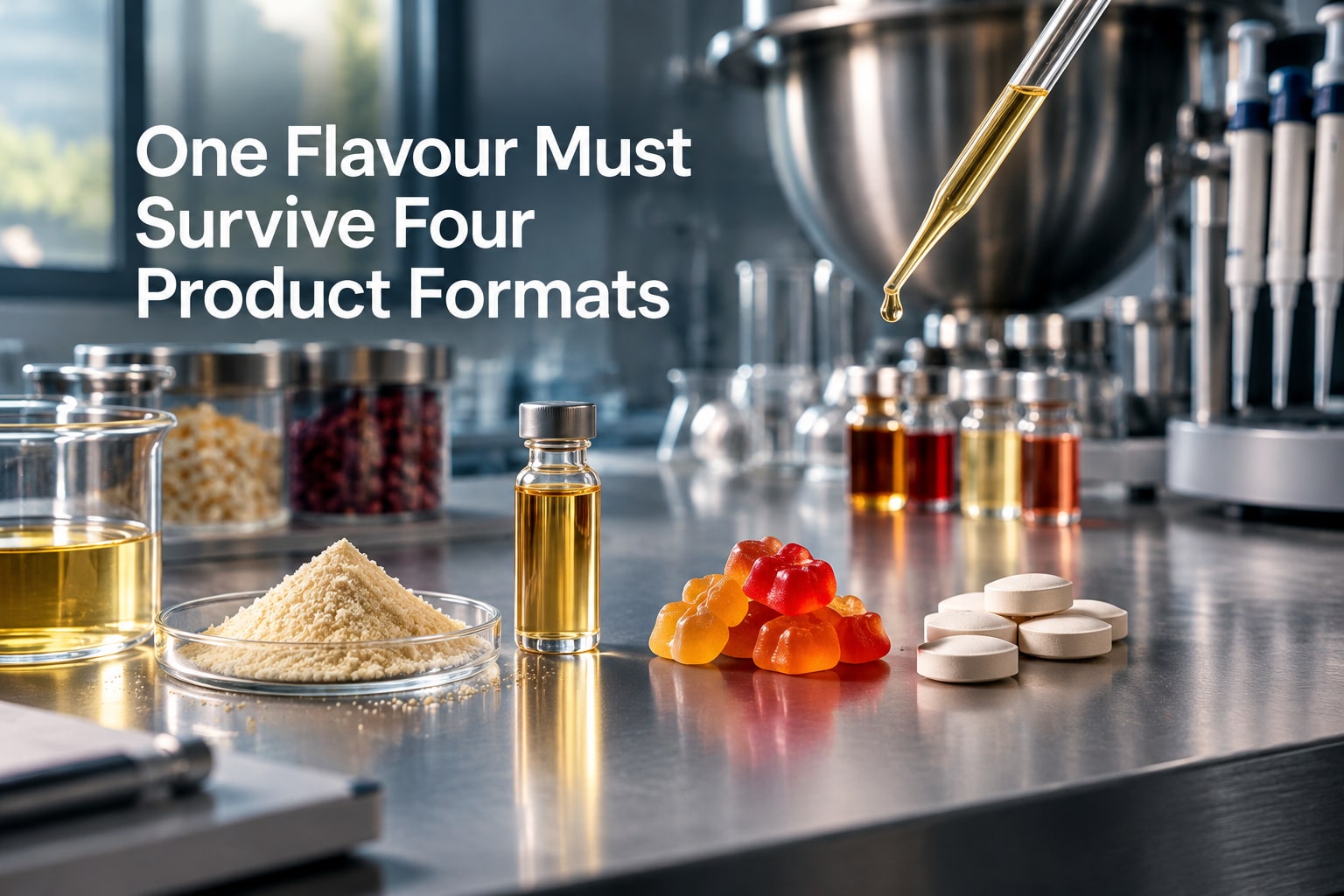
Approve a flavour only after it survives the finished product process, not merely a neat tasting sample. Compare the same brief across formats because heat, moisture, compression and flavour release create different failure points.
| Format | Main approval risk | Evidence to request |
|---|---|---|
| Powders | Poor dispersion, carrier taste or loss of volatile notes | Blend uniformity, bulk density, reconstitution and post-process tasting |
| Liquids | Dilution, separation, preservation or added carrier solids | Solubility, emulsion stability, pH compatibility and packaged stability |
| Gummies | Flavour loss during heating, moulding or storage; sticky aftertaste | Samples before and after cooking, texture hold, water-activity and shelf-life checks |
| Tablets | Weak release, compression heat and flavour interaction with minerals | Blend uniformity, compression-stage sample, dissolution or chew test and packaging stability |
Run approval samples at the proposed use level in the complete formula. Test them before processing, immediately after processing and at defined storage checkpoints in the final pack; include heat, oxygen, light and pH exposure where they match production.
Ask each wellness flavour manufacturer in Johannesburg for a written specification covering flavour direction, dosage range, carrier, colour, allergen status, permitted claim language and processing limits. Confirm whether the product is an oral flavouring preparation, not an external-use fragrance.
For repeat supply, approve a retained reference sample and acceptance description, then record batch-to-batch sensory limits, minimum order, lead time, change-control procedure and continuity plan. Ready made wellness flavours shorten sampling, but a custom system earns approval when bitter botanicals, proteins, minerals or acids defeat the standard profile.
Frequently asked questions
What does custom wellness flavour manufacturing actually change?
It changes the flavour profile and formulation to suit the wellness product’s ingredients, dosage form, processing conditions, target users and brand requirements.
Should a wellness brand choose ready-made or custom flavours?
Choose ready-made wellness flavours when a proven profile fits the product and speed matters. Choose custom wellness flavours when masking, stability, differentiation or dosage-form performance requires a tailored solution.
How should you compare flavour manufacturers in Johannesburg?
Compare their ingestion-use expertise, development process, sample support, technical documents, batch traceability, production capability and ability to test flavours in your finished product.
How should you develop and test a wellness flavour?
Define the sensory problem, screen suitable flavour directions, test samples in the complete formulation, record dosage and processing conditions, and assess taste after storage.
How do you approve flavours across powders, liquids, gummies and tablets?
Evaluate each flavour in its final format because solubility, acidity, sweetness, texture, heat exposure, compression and storage can change sensory performance.