
“Liquid” identifies how a flavour is supplied, while “natural” identifies the origin and permitted production route of its flavouring materials. By separating those terms and testing each option in the finished hookah matrix, you can choose a formulation that remains consistent from the first draw to the end of the heating cycle.
Key takeaways
- Treat liquid as a delivery format, not proof of synthetic origin.
- Match flavour choice to the carrier and heating cycle.
- Run incorporation trials using the actual hookah base.
- Judge suppliers by batch consistency, documents and bowl evidence.
Liquid and natural are not opposite choices
“Liquid” describes the delivery format, not the origin. A liquid hookah flavour may contain natural flavouring substances, synthetic molecules, extracts, or a blend carried in propylene glycol, glycerol, ethanol, water, or another approved medium.
“Natural” describes the source and permitted production route; it may arrive as a liquid extract, oleoresin, essential oil, distillate, or blended preparation.
| Specification term | What it means | Product bases it can serve |
|---|---|---|
| Liquid | A pumpable or pourable flavour preparation | Hookah tobacco, herbal shisha, nicotine-free mixtures, molasses-based products, glycerol or propylene-glycol systems, and flavour beads when the carrier permits incorporation |
| Natural | Flavour material from a named or qualifying natural source, supplied in a suitable preparation | Tobacco and herbal bases, syrup or molasses mixtures, and nicotine-free products when heat stability, solubility, and sensory strength are confirmed |
| Natural liquid | Natural-origin material delivered in liquid form | The same bases as liquid flavour, provided the finished matrix remains uniform during storage and heating |
For customize flavour for b2b hookah products liquid or natural, specify the finished matrix rather than choosing a label alone. Test glycerol, propylene glycol, molasses or syrup, water, and nicotine separately because solubility in the concentrate does not prove stability in shisha.
Ask the supplier for:
- Raw-material origin and production route
- Carrier composition and concentration
- Allergens, residual solvents, pesticides, heavy metals, microbiological status, shelf life, and a batch-specific certificate of analysis
A natural hookah flavour does not make charcoal smoke safe. It also does not replace a hookah-specific inhalation assessment with an IFRA certificate.
Choose the flavour around the carrier and heating cycle
A flavour that is bright in a neat vial can become harsh, flat or burnt after a 60-minute charcoal session. To customize flavour for B2B, start with the finished carrier: glycerol, propylene glycol, molasses or syrup, water, nicotine if present, and the intended moisture level.
| Option | Heat and session fit | Carrier and sensory effect |
|---|---|---|
| Liquid system | Easier to tune for repeated electric-heater cycles and long sessions; select heat-stable components | Suits uniform distribution in glycerol- or propylene-glycol-rich bases; supports precise, clean top notes |
| Natural flavouring substances | Useful when a recognisable botanical profile matters and heat exposure is controlled | Check solubility, oxidation and harshness in syrup, molasses and high-moisture bases; an essential oil is not automatically suitable for inhalation |
| Extract, essential oil or blend | Can add depth, but volatile terpenes and aldehydes can fade or decompose under charcoal heat | Best evaluated for body, aftertaste and smoke interaction rather than aroma alone |
High moisture and dense packing slow flavour release, while a dry, loose matrix can create an early burst followed by a hollow finish. Match the formulation to the target: citrus and mint need controlled volatility, whereas tobacco, spice and dessert profiles need heat-resistant base notes.
Condition samples in the actual shisha matrix, then test the unheated concentrate, finished mixture and headspace during representative charcoal or electric-heater cycles. Request a natural hookah flavour only with intended-use information; food-use approval alone does not establish inhalation safety. A room-temperature blotter cannot predict the bowl.
Build a repeatable incorporation and mixing trial
Use three 1 kg screening batches at 0.25%, 0.50% and 1.00% flavour, measured by weight against the complete hookah matrix. These are development points, not universal production dosages. A liquid hookah flavour manufacturer should confirm the concentrate strength and recommend a narrower range for your tobacco, herbal, molasses-based or nicotine-free base.
- Prepare a 10–20% premix of the flavour in a compatible carrier, such as propylene glycol for a PG-rich base or glycerol for a glycerol-rich base. Do not add an essential oil directly to water or assume a clear concentrate will remain uniform.
- Blend glycerol, propylene glycol, molasses or syrup and water until the base is uniform. Add the flavour premix slowly under agitation, then add nicotine last where applicable and permitted by your process.
- Mix each 1 kg batch for 10–15 minutes with a propeller mixer at moderate speed. Use high-shear homogenisation for 2–5 minutes when you see oil separation, haze or sediment, while avoiding foam and excessive heat.
- Seal the batches and rest them for 24 hours at 20–25°C. Inspect at 0, 24 and 72 hours for separation, colour drift, sediment and aroma loss before sensory testing.
Record ingredient weights, mixer speed, temperature, batch number and addition times. To customize flavour for b2b production, repeat the winning dose in a 5–10 kg pilot batch and compare its uniformity after conditioning, transport simulation and the intended packing process.
Test the finished bowl, not just the concentrate
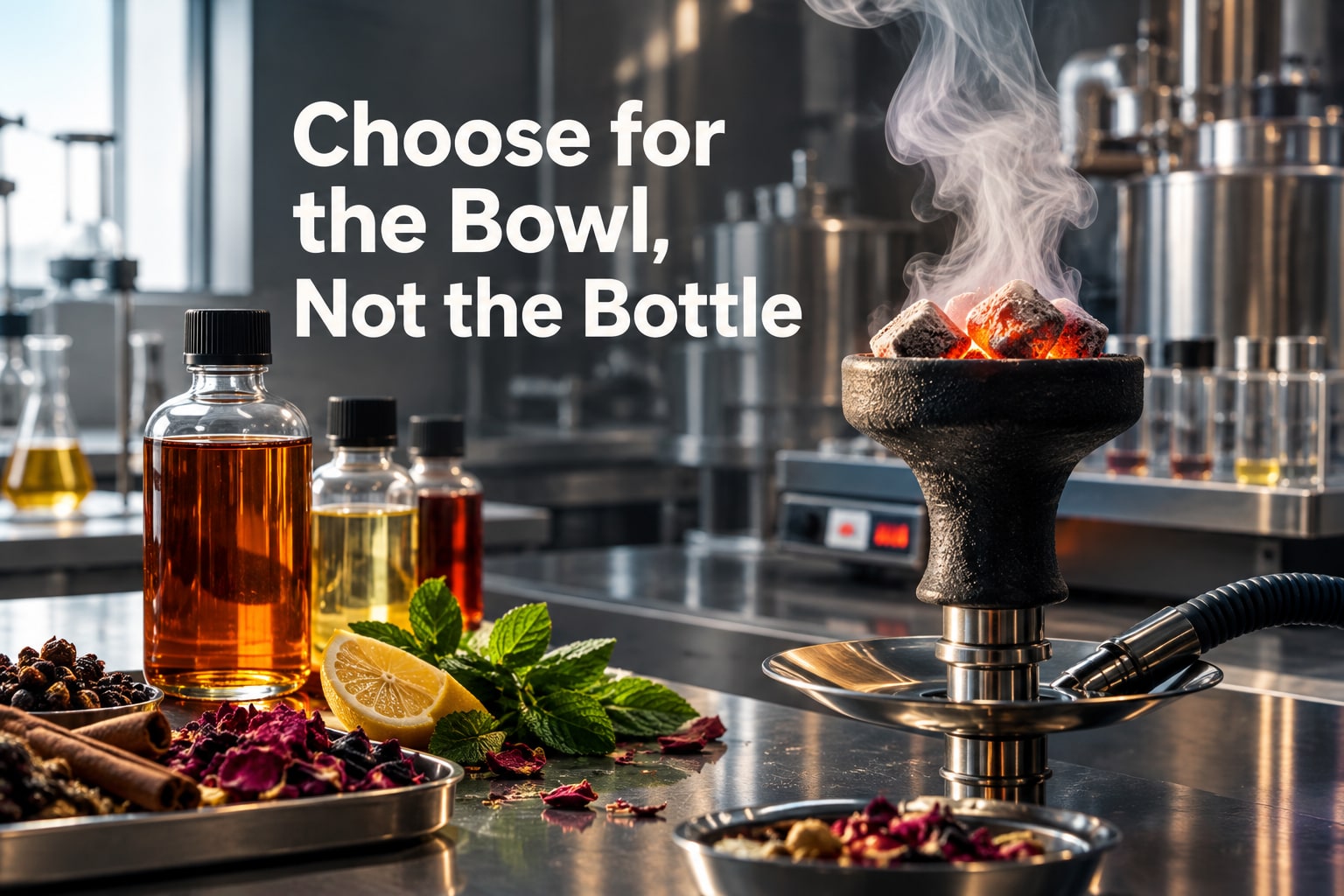
Approve a sample only after it survives a full, timed bowl. To customize flavour for b2b hookah products liquid or natural, test both in the customer’s finished tobacco or herbal matrix, not as neat concentrate on a blotter.
| Sample | Controlled preparation | Record |
|---|---|---|
| Liquid | Same base, dose, mixing order and conditioning period as production | Top-note strength, haze, separation and flavour at each draw |
| Natural | Same finished matrix, bowl mass, packing density and moisture as liquid | Aroma release, bitterness, colour shift and late-session harshness |
| Both | Separate bowls under matched charcoal or electric-heater settings | Headspace or emissions sample, draw resistance and session endpoint |
Run a fixed protocol:
- Use the same bowl, foil or heat-management device, water level, airflow, charcoal mass and placement. For an electric heater, record the setting and measured surface temperature.
- Condition each finished batch for the defined resting period, then weigh the same charge and pack it to the same density.
- Rate the unheated concentrate, the prepared matrix, and the bowl at start, midpoint and final draw. Record sweetness, identity, smoke harshness, cooling, bitterness and loss of top notes.
- Repeat enough bowls to separate formulation variation from operator error, and photograph oil separation, haze, sediment or colour drift.
A sample fails when flavour disappears early, turns burnt or bitter, becomes harsh after heat builds, separates in the base, or changes materially between bowls. Ask a liquid hookah flavour manufacturer for this application evidence, not only a room-temperature approval.
Charcoal emissions remain a separate exposure issue; a natural choice does not remove carbon monoxide or other smoke pollutants.
Compare suppliers by consistency, documents and application evidence
A natural hookah flavour and a liquid format are not competing supplier categories. A liquid hookah flavour manufacturer may supply synthetic, natural or blended material, while a natural hookah flavour may arrive as an extract, oleoresin, essential oil or distillate.
| Supplier type | Commercial fit | Evidence to demand |
|---|---|---|
| Natural specialist | Choose for origin-led positioning and distinctive botanical profiles | Raw-material origin, production route, allergen statement, pesticide and heavy-metal results |
| Liquid specialist | Choose for controlled dosing, carrier compatibility and repeatable incorporation | Carrier composition, concentration, solubility, stability data and packaging-compatibility results |
| Supplier offering both | Choose when you need side-by-side trials or one partner for multiple bases | Matched samples, identical test conditions, batch history and change-control procedure |
Ask a hookah sheesha flavour manufacturer, including Khattri Aromas LLP, to provide these checks before approval:
- A batch-specific certificate of analysis covering identity, concentration, microbiological status, residual solvents, allergens, pesticides, heavy metals and shelf life.
- Application evidence in your actual base: hookah tobacco, herbal shisha, nicotine-free mixture, molasses carrier or flavour beads. Check oil separation, haze, sediment, colour drift, top-note loss and packaging migration after heat, light, freeze-thaw and transport simulation.
- Intended-use information and inhalation- or thermal-relevant toxicology where available. Food-grade status does not prove suitability after pyrolysis; an IFRA certificate does not replace a hookah-specific assessment.
- For United States sales, documentation supporting FDA establishment registration, product listing, ingredient reporting, health-document reporting and premarket authorisation where applicable. A clear concentrate alone proves little.
Frequently asked questions
Are liquid and natural hookah flavours opposite choices?
No. Liquid describes the delivery format, while natural describes the origin of flavouring substances. A liquid flavour can contain natural substances, synthetic molecules, extracts or a blend.
How should you choose a flavour for B2B hookah products?
Choose it around the carrier and heating cycle. Check how the flavour disperses in your base and how its aroma and taste perform under the product’s actual heating conditions.
Why test the finished hookah bowl instead of only the concentrate?
The concentrate does not show the complete product result. Test the finished bowl to assess flavour release, aroma, taste and consistency after incorporation and heating.
What should you compare when selecting a hookah flavour supplier?
Compare batch consistency, origin and carrier information, technical documents, incorporation guidance and evidence from application testing in the finished product.