
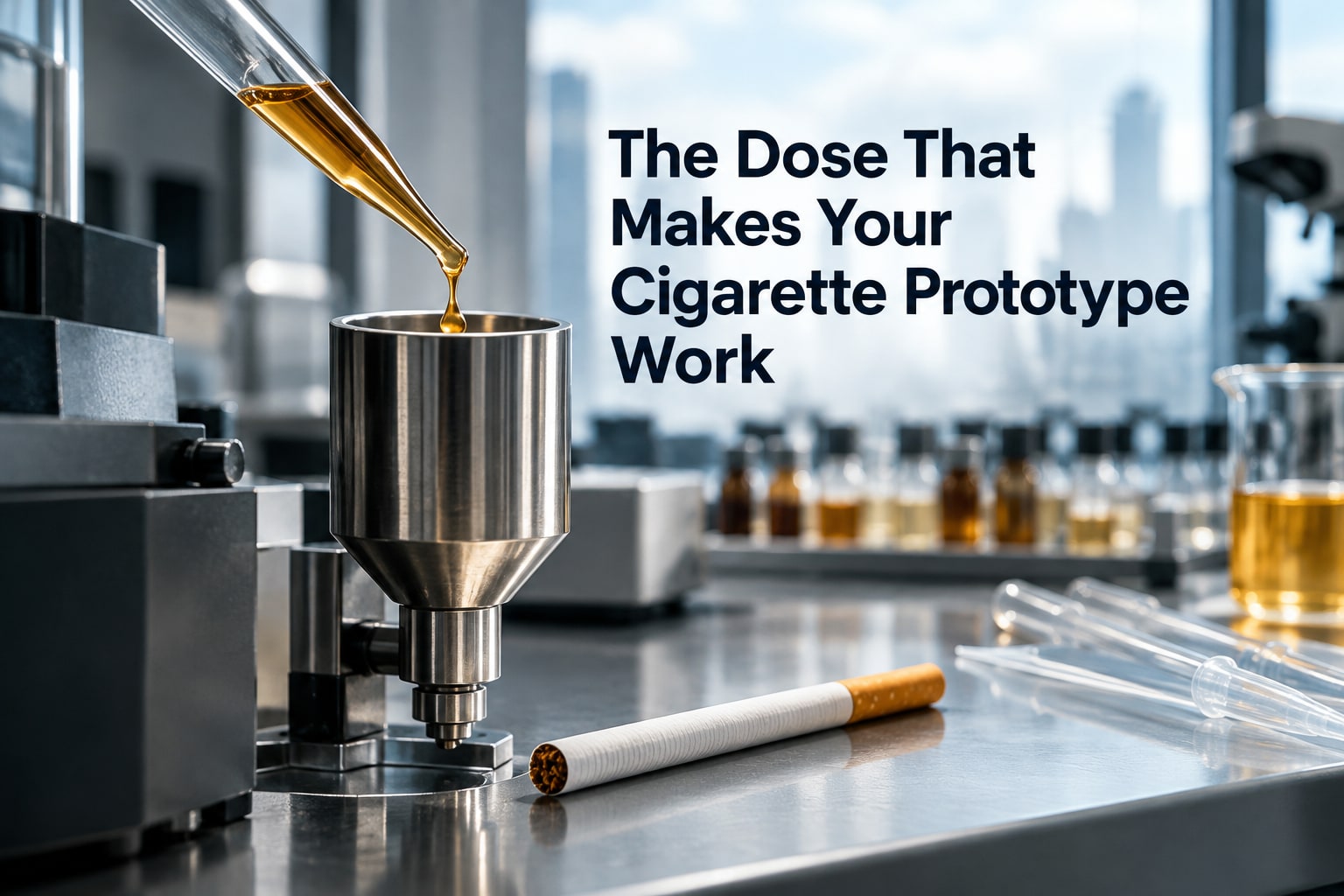
A liquid that smells convincing in a sample bottle can fail after it is diluted, sprayed on tobacco, conditioned, stored, heated, and smoked. By the end, you will know how to specify deposited dose, choose the right application stage, test a supplier, and move a cigarette flavour from laboratory trial to production with the required records.
Key takeaways
- Apply casing liquid earlier and top flavour later in the cigarette process.
- Set dose against tobacco weight, dilution, carrier, and application method.
- Condition prototypes before judging aroma, taste, harshness, or smoke character.
- Ask manufacturers for repeatability data, application guidance, and prototype support.
Where Liquid Flavour Enters the Cigarette Process
Apply the liquid flavour to cut tobacco unless the brief specifically targets another cigarette component. Casing liquid is added earlier, often through casing sauce, to influence tobacco body, sweetness, moisture perception, or harshness; top flavour is applied later to create the recognisable aroma in smoke.
A liquid that smells right in the bottle can fail when assigned to the wrong stage.
| Treatment | Main component or route | Purpose and distinction |
|---|---|---|
| Casing | Cut tobacco or casing sauce | Builds body, rounds harshness, and changes sweetness or moisture perception |
| Top flavour | Conditioned cut tobacco | Supplies the distinctive aroma released during smoking |
| Tobacco enhancer | Cut tobacco | Strengthens tobacco character without making the flavour dominant |
| Cooling agent | Tobacco, filter, or controlled delivery system | Creates cooling; judge it after smoking, not by neat-liquid odour |
| Sweetener | Tobacco or casing solution | Softens bitterness and supports sweetness; it is not a full aroma |
| Menthol system | Tobacco, filter, or both | Delivers menthol identity and cooling with timing controlled by the system |
| Aroma-only treatment | Paper, filter, or wrapper | Adds external aroma and does not replace tobacco treatment |
For a liquid flavour manufacturer cigarette flavour for development in Delhi NCR, ask for tobacco-specific trials, not a food-flavour catalogue. Compare prototypes at matched deposited dose and record blend, application route, conditioning, and machine-smoked or panel results. That evidence shows whether the flavour survives adsorption, heating, combustion, and smoke dilution.
How to Set Dose, Dilution, Carrier, and Application Conditions
Set the trial by deposited flavour on tobacco, not by the concentration of the neat liquid. Choose three pre-agreed rates, such as 0.1%, 0.3%, and 0.5% w/w, then keep the carrier percentage constant so blend comparisons remain meaningful.
- Weigh the same tobacco mass for every sample and record blend composition, tobacco moisture, flavour dose, carrier, and final batch weight.
- Prepare potent materials as gravimetric stock dilutions. Do not pipette a trace material directly into a large batch; serial dilution reduces weighing error and supports production scale-up.
- Apply the liquid through the intended route, such as a calibrated spray onto cut tobacco or addition to casing sauce. Record nozzle, spray rate, mixing time, application temperature, and equipment.
- Identify the carrier by name and percentage: ethanol, propylene glycol, water, or another approved solvent. Keep carrier loading separate from flavour loading because it changes moisture, drying, and smoke delivery.
- Condition every treated sample under the same sealed temperature, humidity, and time protocol; for example, 24 hours at 22 ± 2°C. Use the same cigarette-making settings and record rod weight, circumference, filter, and paper.
- Evaluate coded samples after conditioning through machine smoking under one fixed regime, such as ISO 3308, and through a controlled sensory panel. Compare menthol or cooling systems at matched deposited doses, not matched liquid concentrations.
- Have the cigarette flavour manufacturer repeat the best treatment in a second blend and pilot batch, then compare transfer, intensity, off-notes, and stability before changing the formula.
From Sensory Brief to Conditioned and Smoked Prototype
A pleasant-smelling concentrate proves almost nothing about cigarette performance. Heating, tobacco adsorption, smoke dilution, combustion, and transfer into mainstream smoke can alter both intensity and character, so judge the flavour on conditioned tobacco and after smoking.
1. Translate the sensory brief into targets: tobacco enhancement, casing sweetness, top-note identity, cooling timing, smoke impact, acceptable off-notes, and the intended cigarette format. Record the tobacco blend, filter, paper, and target deposited dose.
2. Screen tobacco-suitable liquids at matched deposited doses, not equal neat-liquid concentrations. For each trial, record tobacco weight, dilution, carrier, application method, moisture, and addition rate.
3. Apply the candidate to cut tobacco by a defined spray or casing process, then seal and condition it for a fixed time and temperature. Keep untreated tobacco and a known reference as controls.
4. Make a lab cigarette or pilot batch, then assess it by machine-smoking and a trained blind panel. Compare pre-light aroma, smoke aroma, taste, harshness, sweetness, cooling onset, cooling persistence, and aftertaste.
5. Check the liquid and treated tobacco for colour drift, sediment, phase separation, odour change, container interaction, spray performance, moisture change, and sensory loss under intended and accelerated storage conditions.
6. Review the approved prototype for regulatory documentation, raw-material availability, and process compatibility before scaling. Define the approved match, formula ownership, reuse rights, and reformulation procedure in writing; “customize flavour manufacturer” is not evidence of exclusivity.
A failed smoked prototype needs a controlled adjustment, not a stronger concentrate by instinct. Change one variable at a time, repeat the application, and confirm the result on a second pilot batch.
How to Qualify a Liquid Flavour Manufacturer in Delhi NCR
Approve a liquid flavour manufacturer in Delhi NCR only after checking the site, documents, and tobacco trial—not the aroma of a neat sample. A local sales office is not proof that compounding, testing, or batch release happens nearby.
1. Visit or audit the actual compounding and quality-control site. Ask for a tobacco-specific workflow showing controlled application to casing or top-flavour stages, deposited dose, carrier percentage, tobacco moisture, conditioning time, and machine-smoking or blind sensory comparison. Reject a supplier that offers only food-flavour catalogue samples.
2. Request a representative certificate of analysis, safety data sheet, allergen declaration, restricted-material declaration, batch number, raw-material traceability record, and retained-sample policy. Confirm that the supplier evaluates the treated tobacco after conditioning and smoking, because heat, adsorption, combustion, and smoke transfer can change the liquid’s character.
3. Run a reproducibility check: give the supplier an approved reference batch and compare two coded pilot batches against it. Record the acceptance criteria for aroma, smoke impact, intensity, colour, appearance, and deposited dose rather than approving a pleasant-smelling bottle.
4. Put minimum order quantity, sample and production lead times, packaging, shelf life, storage, price review, and change-notification periods in writing. The agreement must identify formula ownership, customer-specific raw materials, reuse rights, reformulation procedure, and what counts as an approved match; “customized” does not mean exclusive.
Khattri Aromas LLP should be assessed against this same evidence, including its ability to reproduce an approved cigarette flavour batch at pilot scale.
Choosing Liquid Formulation Over Other Flavour Formats
Choose liquid when you need precise deposited dose, quick adjustment, and separate control of casing or top-flavour performance. It is the better development format when the flavour must be sprayed onto cut tobacco, diluted in a defined carrier, and compared across pilot batches.
| Option | Main advantage | Choose it when |
|---|---|---|
| Liquid flavour | Precise dosing and rapid reformulation | You need controlled casing or top-flavour trials |
| Powder flavour | Dry handling and easier transport | Water or solvent addition is undesirable |
| Emulsion | Disperses oil materials in water | The process requires a water-based application |
| Encapsulated flavour | Delayed or protected release | Heat, storage, or staged release threatens the flavour |
| Ready-made tobacco blend | Fast route to a pre-composed profile | You accept limited control over individual components |
Liquid loses its advantage when the plant cannot reproduce nozzle pressure, carrier ratio, tobacco moisture, conditioning time, or deposited dose. A bottle concentration is not a scale-up specification; record flavour mass per tobacco mass and verify the result after conditioning and smoking.
Settle ownership before development begins. The agreement must state:
- Who owns the final formula, brief, trial data, and approved reference sample
- Whether the supplier may reuse the composition, aroma profile, or customer-specific raw materials
- What qualifies as an approved match, including sensory tolerance and batch variation
- Who pays for reformulation if a raw material disappears, changes grade, or becomes restricted
“Customize flavour manufacturer” is a service description, not proof of exclusivity. Ask a liquid flavour manufacturer in Delhi NCR to document these rights and reproduce the approved pilot batch.
Frequently asked questions
Where does liquid flavour enter the cigarette manufacturing process?
Apply liquid flavour to cut tobacco unless the brief targets another component. Casing liquid enters earlier through casing sauce, while top flavour is applied later to shape recognisable smoke aroma.
How should you set dose, dilution, carrier, and application conditions?
Define the dose against tobacco weight, then record the dilution, carrier, spray or mixing method, application temperature, and holding time so prototypes can be compared consistently.
How do you evaluate a conditioned and smoked cigarette prototype?
Condition the treated tobacco and finished prototypes before sensory review, then compare aroma, taste, harshness, sweetness, smoke character, and batch-to-batch consistency against the brief.
How do you qualify a liquid flavour manufacturer in Delhi NCR?
Ask for relevant manufacturing and quality documents, traceability from raw material to batch, repeatable dosing guidance, sample support, and evidence that the formulation suits your application process.
When is a liquid formulation preferable to another flavour format?
Choose a liquid when you need controlled dosing, straightforward dilution, direct application to cut tobacco, or rapid adjustment during prototype development. Compare handling, stability, and process fit before selecting the format.