

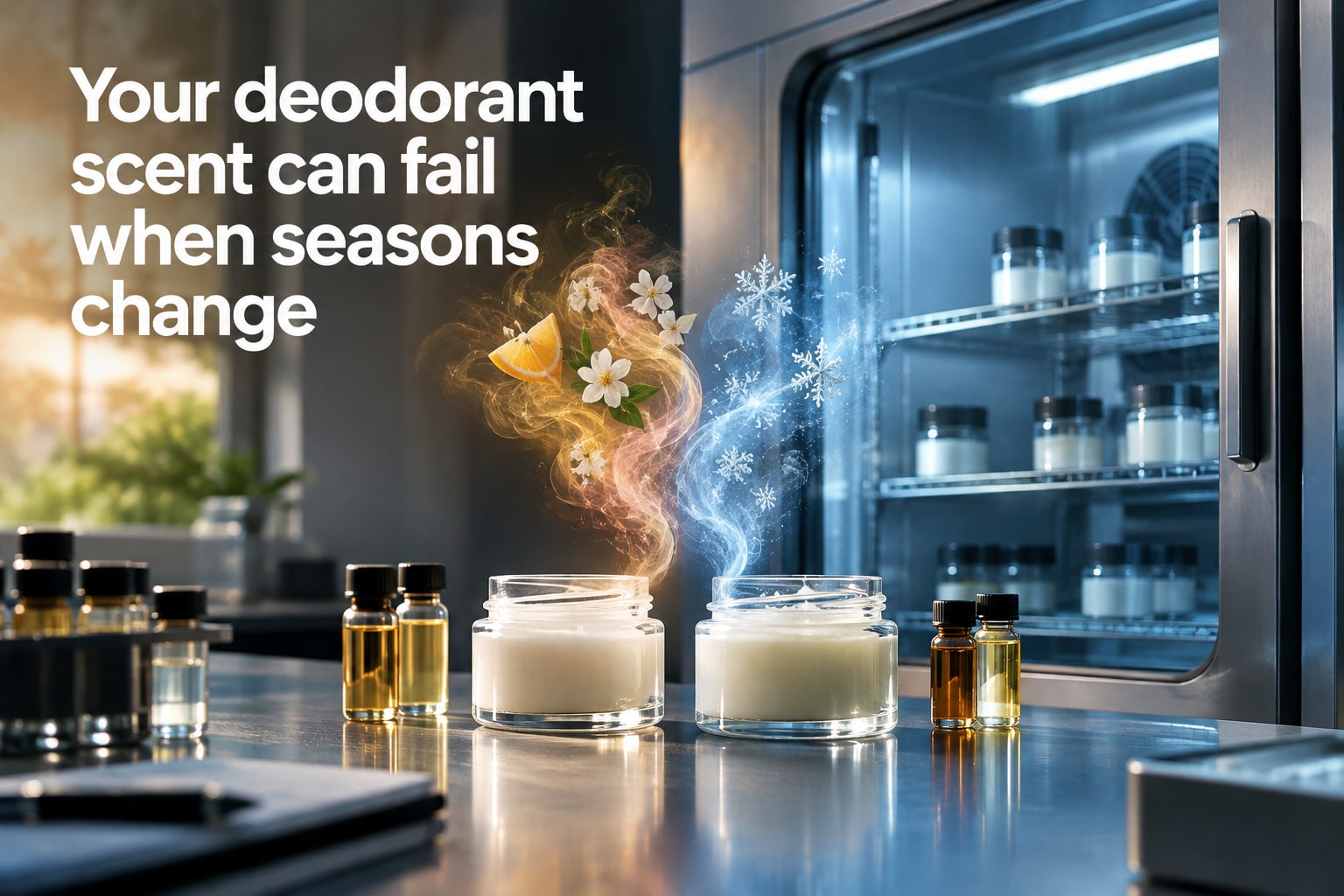
A deodorant that smells fresh in a Delhi NCR laboratory can lose its top notes in summer, turn sour after storage, or cloud and separate during cooler transport. By the end, you will be able to identify whether the failure comes from the fragrance, base, package, or odor-control system, then specify a seasonal trial that produces useful evidence.
Key takeaways
- Match fragrance dosage to the deodorant base, not the season alone.
- Test scent, colour, viscosity, and packaging at hot and humid conditions.
- Compare fragrance samples after defined storage and freeze-thaw cycles.
- Ask Delhi NCR manufacturers for stability data and batch traceability.
Why the same deodorant fragrance behaves differently by season
Temperature and humidity change how a deodorant fragrance evaporates, releases odour, remains stable, and feels fresh. The same formula can smell bright in one season and weak, harsh, or stale in another.
- Summer heat speeds evaporation and oxidation, while aerosol headspace pressure rises.
- Monsoon humidity stresses water-containing formulas, seals, labels, and other packaging components.
- Cooler storage can reveal crystallization, wax precipitation, or clouding hidden at room temperature.
These seasonal deodorant fragrance problems are not solved by judging the opening note alone. A fragrance balanced on a blotter can turn harsh, flat, metallic, soapy, or overly sweet during several hours of dry-down as sweat, salts, skin microbiota, polymers, antiperspirant actives, and skin temperature alter evaporation.
Perfume impact is not odor-control proof. Fragrance can mask axillary odor, but it does not demonstrate antibacterial, antimicrobial, or 24-hour odor-protection performance; those claims require separate testing.
Citrus and terpene-rich briefs need extra scrutiny. Limonene and linalool can oxidize into hydroperoxides with greater skin-sensitization relevance than the original materials. Evaluate oxygen exposure, light exposure, antioxidant strategy, and the odour of aged samples, not only the fresh opening.
A blotter cannot reproduce skin, sweat, packaging, or the deodorant base. Screen a custom body care fragrance in the finished spray, roll-on, gel, cream, or stick, then record skin and fabric dry-down over several hours. Assess fragrance loss, haze, precipitation, colour change, and aged odour under the customer’s actual transport and storage conditions.
How to diagnose a seasonal scent or appearance failure
Compare an unopened control with finished deodorant samples aged at room temperature and around 40°C. Record odor at application and after several hours, color, clarity, pH, viscosity, leakage, and package condition; use a cold or freeze–thaw check for winter transport or cold warehouses.
- Rapid top-note loss or storage fading: if only the aged sample changes odor, investigate oxidation, oxygen exposure, light, and fragrance-material stability, especially in citrus or terpene-rich formulas.
- Sour or stale odor: pH drift, gas, viscosity loss, or microbial indicators point to spoilage or base failure, not automatically to the fragrance.
- Haze, separation, or color change: examine water, salts, emulsifiers, polymers, waxes, glycols, silicones, preservatives, and antiperspirant actives.
- Stable liquid but poor spray: inspect the actuator, valve, gasket, dip tube, can, propellant, and fill pressure.
- Pack-linked change: test plastic adsorption, fragrance permeation, closure extraction, and liner interaction in the intended bottle, can, actuator, valve, and closure.
| Finding | Next comparison | Main direction |
|---|---|---|
| Aged odor only | Control versus 40°C sample | Oxidation or light exposure |
| Base clarity changes | Fragrance-free base versus finished product | Formula compatibility |
| Spray fails, liquid stable | Same fill in approved and test components | Valve or package function |
| Skin differs from fabric | Concentrate, skin, and fabric dry-down | Substrate interaction |
Evaluate skin and fabric separately from the concentrate, recording dry-down over several hours. This fault-finding sequence exposes seasonal deodorant fragrance problems before approval.
Which fragrance format and dosage suit the deodorant base
Alcohol-soluble does not mean deodorant-compatible. Test liquid fragrance for deodorants in the finished spray, roll-on, gel, cream, or emulsion against its water, salts, polymers, propellant, and antiperspirant actives.
| Format | Advantage | Main risk |
|---|---|---|
| Liquid fragrance | Flexible for most deodorant formats | Haze, precipitation, separation, or colour change in the finished base |
| Fragrance oil | Strong perfume impact and easy oil-phase dosing | Poor water compatibility and unstable spray or emulsion clarity |
| Encapsulated fragrance | Delayed or wear-triggered release | Shear, storage, base, and package compatibility failures |
| Essential-oil blend | Natural-positioning story | Oxidation, allergens, colour, and skin-sensitisation concerns |
| Pre-compounded base | Less development work | Less control over identity and seasonal adjustment |
Screen a custom body care fragrance in the actual base, not only on a blotter. Record solvent system, water content, target clarity, colour limit, packaging, skin dry-down, and odour after several hours.
Use these starting fragrance-load ranges for trials, not as universal answers:
- Sprays and roll-ons: about 0.2–1.0%
- Gels and creams: about 0.3–1.5%
- Sticks: about 0.5–2.0%
- Aerosols: about 0.1–0.8%
Confirm the safe level in the finished formula and intended market. Under IFRA categorisation, underarm deodorants and antiperspirants are generally Category 2; check the current IFRA Standard and certificate of conformity for the finished-product dosage. A stronger first impression is irrelevant if the product clouds, separates, or irritates during storage and wear.
How to run a seasonal deodorant fragrance trial
Record the finished format before blending: hydroalcoholic spray, pump spray, roll-on emulsion, gel, cream, wax stick, or aerosol. For each sample, document the complete base, liquid fragrance for deodorants load, water content, solvent system, pH, active salts, propellant, preservative, and packaging components.
- Prepare an unfragranced control and at least two fragrance prototypes at recorded dosages. Use the finished deodorant base, not fragrance oil alone.
- Store samples under conditions that match the customer’s transport and warehouse profile. Include humidity-controlled assessment, repeated temperature cycling, and light exposure.
- Run freeze–thaw checks when the formula contains waxes, emulsions, or crystallization-sensitive materials. Cold exposure can reveal haze, wax precipitation, or separation missed at room temperature.
- For aerosols, measure spray pattern, droplet size, cooling sensation, valve function, leakage, can compatibility, and flammability controls. Do not transfer approval from a pump spray; propellant and fill pressure change spray behaviour and fragrance impact.
- Inspect every sample for appearance, application odour, dry-down after several hours, fabric transfer, nozzle or actuator blockage, pH, viscosity, and package condition. Keep separate results for fragrance performance, odor-control testing, and antiperspirant efficacy.
| Condition | What to compare | What it reveals |
|---|---|---|
| Room temperature | Control and prototypes | Baseline clarity, odour, pH, and viscosity |
| Around 40°C | Aged samples against baseline | Evaporation, oxidation, colour change, and package stress |
| Temperature cycling | Repeated hot-and-cold exposure | Seasonal deodorant fragrance problems, separation, and crystallization |
| Light and controlled humidity | Intended pack under warehouse conditions | Fading, permeation, leakage, and moisture effects |
Add real-time stability testing: accelerated results rank prototypes and expose failure modes, but do not prove an exact ambient shelf life.
What to ask a Delhi NCR fragrance manufacturer before approval
Approve a fragrance against a written specification, not a strong opening note. Ask a deodorant fragrance manufacturer for body care in Delhi NCR for the fragrance identity, recommended dosage range, solvent and water compatibility, target clarity, colour limit, allergen or restricted-substance information, applicable IFRA Category 2 documentation, and certificate of conformity.
Give the body care fragrance manufacturer in Delhi NCR these inputs:
- Intended skin-use area, complete base formula, processing temperature, pH, active salts, propellant, and required stability period.
- Package drawing, bottle or can material, valve, actuator, gasket, dip tube, liner, transport route, storage temperatures, and light exposure.
- Acceptance limits for colour, haze, separation, odour change, spray function, skin dry-down, and fabric transfer.
Require prototypes in the finished deodorant—spray, roll-on, stick, cream, or gel—not only on a neat fragrance strip. Khattri Aromas LLP adds practical value when it adjusts a custom body care fragrance against these measurements and tests it in the intended base and pack.
| Format | Check before approval | Failure it can expose |
|---|---|---|
| Hydroalcoholic spray | Clarity, spray pattern, evaporation, actuator function | Haze or rapid top-note loss |
| Roll-on, cream, or gel | pH, salts, viscosity, emulsion stability | Separation or colour drift |
| Stick or aerosol | Wax structure, valve, propellant, leakage | Crumbling, blockage, or poor discharge |
Compare fresh and aged skin performance, fabric behaviour, appearance, package compatibility, and documented safe use. Define an acceptable seasonal change: “fresh in summer” and “long-lasting” mean nothing without dosage, test condition, and pass criterion.
Frequently asked questions
Why does the same deodorant fragrance behave differently by season?
Temperature and humidity change evaporation, odour release, stability, and skin feel, so one formula can smell bright in one season and weak or harsh in another.
How can you diagnose a seasonal deodorant scent or appearance failure?
Compare approved and failed batches for odour, colour, viscosity, separation, packaging interaction, and performance after controlled temperature and humidity exposure.
Which fragrance format and dosage suit a deodorant base?
Choose the format and dosage after checking the base, alcohol or water content, propellant system, solubility, clarity, skin feel, and stability requirements.
How should you run a seasonal deodorant fragrance trial?
Test several controlled fragrance levels in the finished base, store samples under defined conditions, and assess odour, appearance, spray performance, and skin feel over time.
What should you ask a Delhi NCR fragrance manufacturer before approval?
Request the formulation specification, recommended dosage, allergen and regulatory documents, stability results, batch traceability, and evidence that the fragrance suits your deodorant base.