
A fine-fragrance project can fail before production when the brief, concentration, testing plan, and supplier scope are unclear. By defining each stage and comparing the documents, samples, and manufacturing capabilities on offer, you can request a useful quotation and qualify the right partner for launch.
Key takeaways
- Write the brief with target format, concentration, pack, market, and approval criteria.
- Compare stock, modified, and bespoke formulas by speed, exclusivity, cost, and testing needs.
- Evaluate samples on blotter, skin, final pack, and after heat and light exposure.
- Ask for licences, specifications, safety documents, batch records, and change-control procedures.
How a fine-fragrance project moves from brief to production
A fine-fragrance project reaches production through five controlled stages: a complete brief, olfactive development, evaluation, finished-pack testing, and documented approval.
1. Give the manufacturer a brief that names the target consumer, launch market, product format, pack size, expected annual volume, target price, desired olfactive family, competitor references, alcohol or oil base, intended fragrance dosage, shelf-life expectation, and restricted-material requirements.
Without dosage, base, market, or pack details, you invite a quotation for an oil that smells acceptable on a blotter but fails in the finished perfume.
2. The manufacturer translates the brief into an olfactive direction, then creates or selects an initial composition. Evaluation rounds adjust notes, strength, diffusion, dry-down, colour, and base compatibility until the custom fine fragrance solutions meet the technical and sensory target.
3. Approve each sample for first impression, heart, dry-down, blotter performance, skin performance, colour, clarity, and package interaction. Blotters compare diffusion and dry-down; skin trials reveal changes caused by body heat and skin chemistry.
4. Test the finished product in its final pack at elevated temperature, under light, and through freeze-thaw exposure when relevant. Record odour change, colour change, haze, precipitation, leakage, spray performance, and closure interaction.
5. Complete regulatory review, make a pilot batch, approve the final formula, issue production specifications, and obtain written approval for scale-up. Keep the approved sample and batch records so production has a fixed reference, not a verbal scent description.
What to compare: stock fragrance, modified formula, or bespoke development
Choose an existing fragrance when a close olfactive match is acceptable and speed matters; choose bespoke development when scent ownership and technical control matter more.
| Option | What you receive | Best fit and trade-off |
|---|---|---|
| Stock fragrance | An existing composition with little or no modification | Fastest route, but limited exclusivity and fixed dosage or application constraints |
| Modified formula | A proven composition adjusted for strength, notes, colour, performance, or base compatibility | Balances development time with differentiation |
| Bespoke formula | A composition created from your brand brief and technical target | Greater control, but more evaluation rounds, testing, and approval time |
A B2B fragrance manufacturer in Kolkata may quote very different scopes under “custom fine fragrance solutions.” Confirm whether the price covers fragrance compound only, dilution and maturation, filtration, filling and crimping, packaging procurement, regulatory files, stability work, and production support.
Ask the supplier to define the material: fragrance oil, perfume compound, finished perfume, essential-oil blend, or aroma chemical composition. Then confirm whether the quoted price covers concentrate or ready-to-sell product.
Request these commercial and control terms:
- Minimum order quantity, lead time, and sample-retention period
- Batch traceability, certificate of analysis, and change-control procedure
- Formula ownership or exclusivity, plus the number of included revisions
A low concentrate price is not a low launch cost if dilution, filling, testing, or packaging remain outside the quotation.
Choosing the right format, concentration, and fragrance material
Choose the format before requesting samples: it determines performance, cost, carrier, packaging, and testing requirements.
| Format | Performance priority | Technical and cost implications |
|---|---|---|
| Parfum or extrait | Richer load and persistence | Higher concentrate cost; test colour, irritation, staining, and pack compatibility |
| Eau de parfum | Strong, accessible profile | Balance dosage, diffusion, cost, and spray behaviour |
| Eau de toilette | Lift and freshness | Needs suitable volatility and reliable evaporation |
| Body mist | Light application | Lower dosage and a different cost target |
| Attar | Oil-based, close-to-skin wear | Check skin feel, staining, oxidation, bottle, seal, and applicator compatibility |
Alcohol-free perfume needs a water, oil, or alternative carrier. That choice affects clarity, preservation, diffusion, sedimentation, and spray behaviour.
Do not use fragrance-oil percentage as a quality score. Raising dosage can increase impact while also increasing cost, colour, allergen exposure, irritation risk, haze, sedimentation, staining, and incompatibility with pumps, seals, or decorative coatings.
Before asking for custom fine fragrance solutions, state the dosage range, carrier, pack size, application method, target market, and shelf-life expectation. Include the actual bottle and closure components when compatibility matters.
Ask the supplier to identify whether the quotation covers a fragrance oil, ingredient blend, finished alcohol-based perfume, or another intermediate. Compare performance in the intended formula, not the price per kilogram of an undefined concentrate. A blotter that smells good cannot prove skin performance, clarity, stability, or spray behaviour.
How to evaluate samples and prove stability in the final pack
Approve a sample only after you assess its opening immediately, heart development later, and dry-down after several hours. Compare blotters for diffusion, dry-down, and batch-to-batch consistency, then test on skin: body heat and skin chemistry change performance.
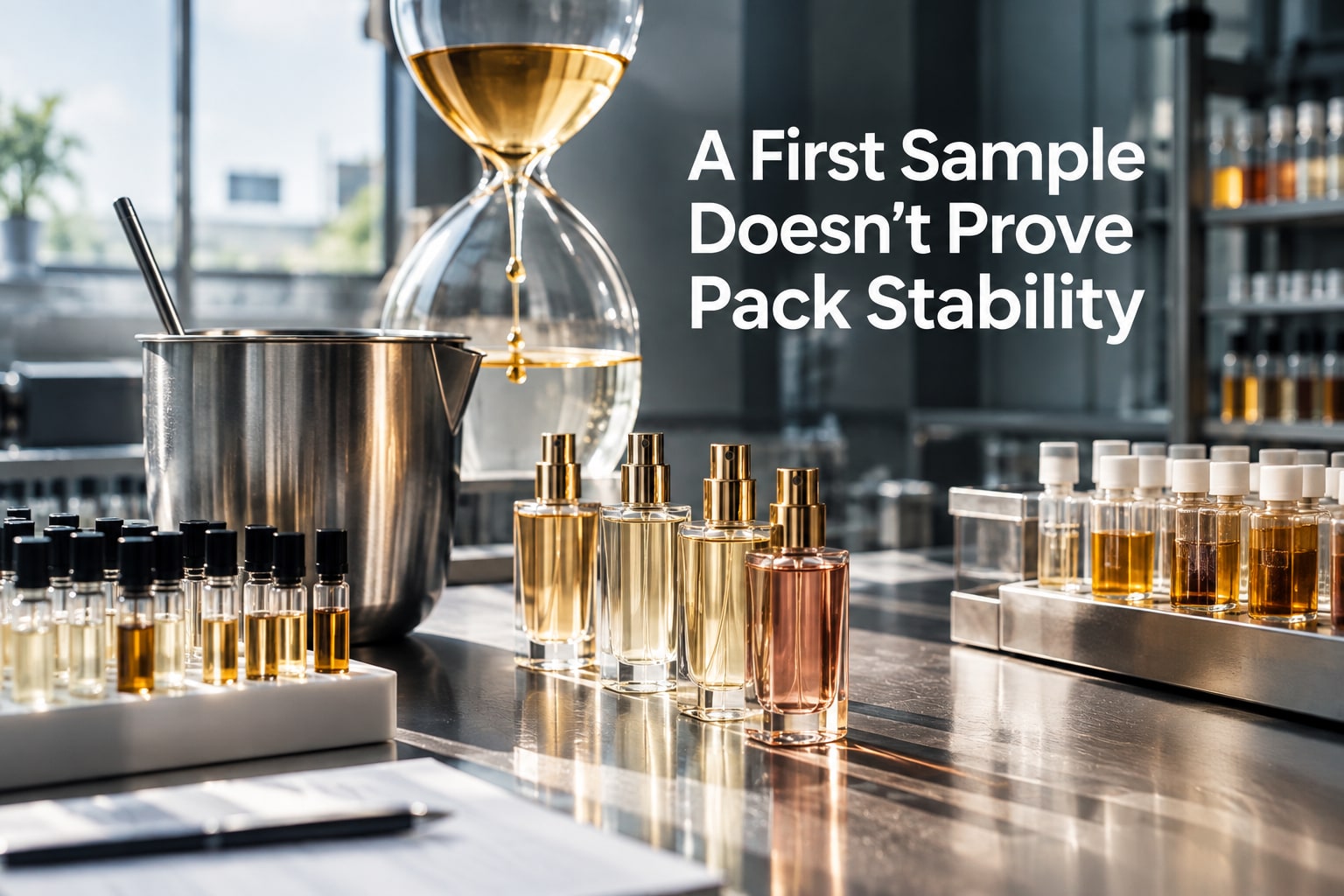
Before approval, record colour and clarity and inspect the finished product in the actual bottle, pump, dip tube, cap, gasket, lacquer, and adhesive. Ethanol and fragrance materials can extract, swell, stress-crack, or transfer odour into packaging. A concentrate in a glass vial cannot prove final-pack stability.
Test the finished alcohol- or oil-based product, not only the fragrance compound.
| Test condition | Inspect | Failure to investigate |
|---|---|---|
| Elevated temperature | Odour drift, colour change, haze, precipitation, evaporation, leakage | Oxidation, extraction, or seal failure |
| Light exposure | Colour and odour change through the bottle | Photodegradation or coating interaction |
| Freeze-thaw, when relevant | Haze, sediment, separation, spray pattern, closure performance | Formula instability or component damage |
Agree with your fine fragrance manufacturer in Kolkata on storage temperatures, light exposure, freeze-thaw cycles, and inspection dates before samples are made. Define acceptance criteria, the evaluation timeline, sample-retention period, and batch-comparison method in writing. Keep approved and rejected references. This evidence shows whether a beautiful laboratory sample survives storage, transport, and daily consumer use.
How to qualify a Kolkata manufacturing partner and its documents
A quote is only comparable after you define what is being supplied. Ask Khattri Aromas LLP whether its proposal covers fragrance-compound development, fragrance-oil manufacture, finished-perfume filling, or full turnkey manufacture, and mark each activity performed in-house. This is the core check when comparing customize fragrance manufacturing companies for fine fragrance in Kolkata.
| Scope | What you receive | What to verify |
|---|---|---|
| Compound development | Fragrance concentrate | Formula ownership, dosage, revisions |
| Fragrance-oil manufacture | Made-to-specification oil | Batch controls, filtration, storage |
| Finished-perfume filling | Filled and packed product | Filling, crimping, packaging responsibility |
| Turnkey manufacture | Development through dispatch | Regulatory file, procurement, production control |
Request these documents and commercial terms:
- Ingredient declaration or composition disclosure under confidentiality, plus an allergen statement and Safety Data Sheet.
- Certificate of Analysis, batch specification, sample-retention procedure, and lot traceability procedure.
- Stability data and packaging-compatibility results covering the actual bottle, pump, gasket, cap, and closure.
- Minimum order quantity, lead time, formula ownership, and change-control terms.
For fine fragrance, request the latest IFRA conformity document for the intended Category 4 use. It applies to that formula and use; it does not certify the finished perfume, packaging, factory, claims, or safety assessment. For European Union sales, check Regulation (EU) 2023/1545 allergen labelling at the 0.001% leave-on threshold in the finished cosmetic.
Review Indian cosmetics, labelling, safety, and standards requirements separately. ISO 22716 supports GMP qualification, not IFRA conformity or finished-product safety. A fine fragrance manufacturer in Kolkata or any b2b fragrance manufacturer in kolkata should answer each point in writing.
Related product
 | Fragrances Customized Fragrance Solutions for Perfume Brands, Signature Fine Fragrances Crafted for Premium Brands Fine fragrances are an expression of... View product → |
Frequently asked questions
How does a fine-fragrance project move from brief to production?
It progresses through a complete brief, olfactive development, sample evaluation, finished-pack stability testing, and documented approval.
What should you compare when choosing a fragrance formula?
Compare a stock fragrance, modified formula, and bespoke development by exclusivity, development time, cost, minimum order, and testing requirements.
How do you evaluate a fine-fragrance sample?
Assess it on blotter, skin, and in the final pack, then check odour, colour, clarity, and performance after stability testing.
Which documents should you request from a Kolkata fragrance manufacturer?
Request the manufacturing licence, product specification, safety data sheet, allergen declaration, certificate of analysis, batch records, and change-control details.