
The word “essence” does not tell you whether a beverage flavour is natural, nature-identical, artificial, extracted, emulsified, or suitable for your process. By comparing source, labelling, beverage compatibility, stability, dosage, testing, and delivered cost, you can select a flavour option and supplier based on the finished drink rather than the sample name.
Key takeaways
- Treat “food essence” as a commercial description, not a regulatory flavour category.
- Choose water-soluble, emulsion, or encapsulated flavour based on the beverage matrix.
- Test dosage across pH, heat, carbonation, storage, and packaging before approving production.
- Compare suppliers using specifications, samples, batch records, and scale-up support.
What “food essence” means compared with natural and other flavour categories
“Food essence” does not tell you what the flavour contains or how you can label it. It is a commercial product description, not a dependable regulatory category.
An essence can contain natural flavouring substances, nature-identical substances, artificial substances, or a mixture, so ask for the formulation, specification, allergen statement, traceability records, and intended FSSAI labelling category.
| Option | What it means | Labelling and practical implication |
|---|---|---|
| Food essence | A marketed flavour product; its source can vary | Do not label it “natural” from the sales name |
| Natural flavour | Derived from plant, animal, or microbiological material through permitted physical, enzymatic, or microbiological processes | Source and production route support the applicable natural-flavour declaration |
| Nature-identical flavour | A substance made to match one found in nature | It is not the same as a natural flavour for label purposes |
| Artificial flavour | A flavouring substance not classified as natural or nature-identical | Use the declaration required for the applicable Indian category |
A natural flavour may arrive as an extract, distillate, reaction flavour, emulsion, or encapsulated powder. These forms affect performance: an oil-soluble extract can separate in water, while an emulsion can cause clouding, sediment, ring formation, or foam.
When comparing a food essence manufacturer versus natural food flavour manufacturer in Kolkata, compare source documentation, sensory consistency, heat and pH stability, shelf life, allergen controls, cost, and lead time.
A food essence manufacturer in Kolkata is not automatically less compliant, and a natural food flavour manufacturer is not automatically better; the supplier’s records decide that.
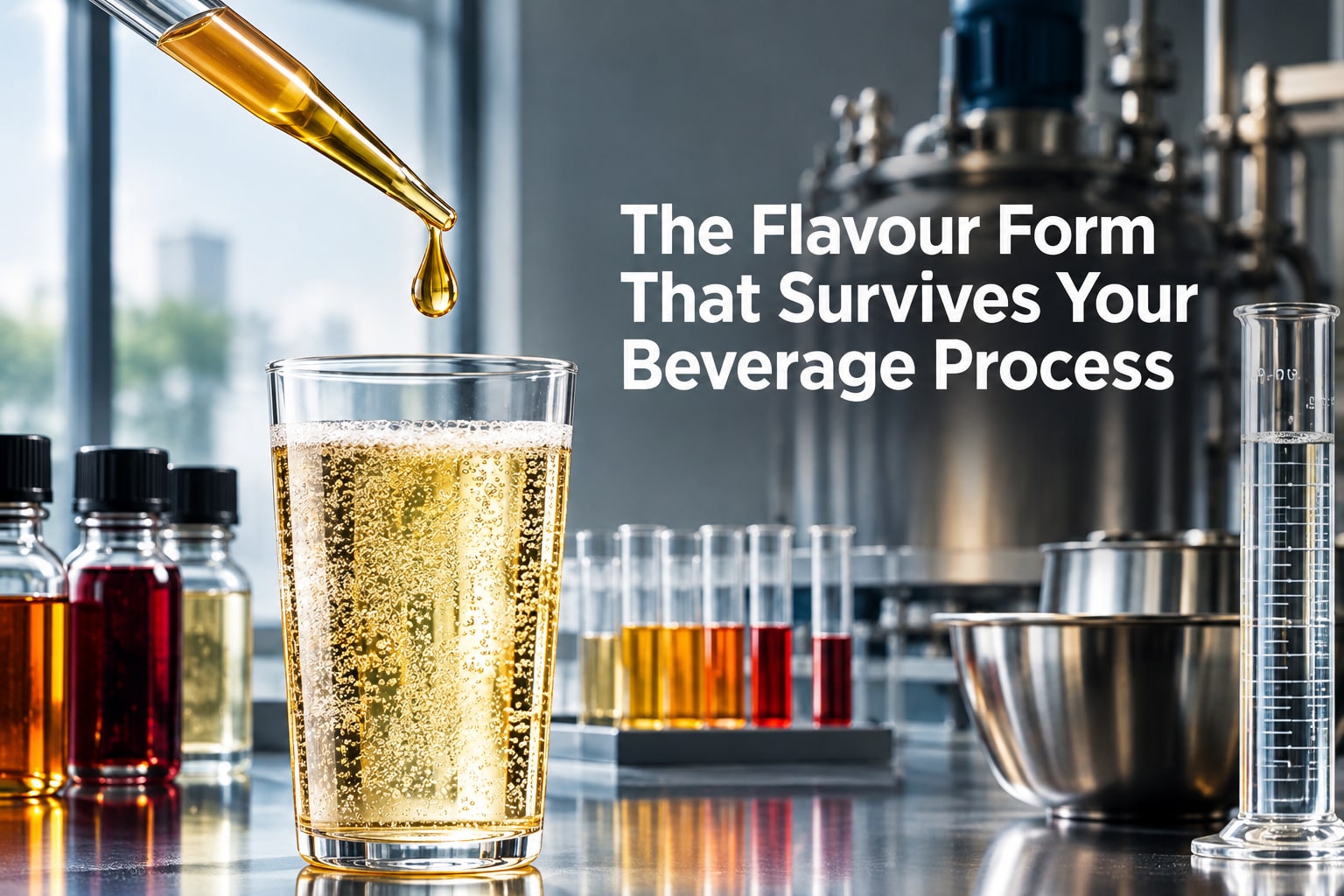
Which flavour form fits your beverage and its physical properties
Choose the delivery form by the beverage’s matrix, not by the flavour name. A water-soluble liquid suits a clear drink; an emulsion suits oil-based citrus notes or products that need cloud.
| Beverage | Suitable flavour type and form | Main checks |
|---|---|---|
| Carbonated drinks | Water-soluble liquid or stable emulsion | Carbonation, foaming, ring formation, and separation |
| Fruit beverages | Natural extract, distillate, or emulsion | Acidity, cloud stability, sediment, and pulp compatibility |
| Dairy drinks | Water-dispersible emulsion or encapsulated flavour | Protein interaction, pasteurisation heat, and storage stability |
| Syrups | Concentrated water-soluble liquid | High Brix, preservative compatibility, and flavour uniformity |
| Energy drinks | Acid-stable water-soluble liquid | Low pH, vitamins, minerals, caffeine, and heat exposure |
| Powdered drinks | Spray-dried or encapsulated powder | Instant dispersion, moisture pickup, and flavour retention |
| Alcoholic beverages | Alcohol-soluble extract or compatible liquid flavour | Ethanol level, haze, extraction, and package interaction |
| Ready-to-drink products | Process-stable liquid, emulsion, or encapsulated form | Filling temperature, shelf life, light, and oxygen |
Do not put an oil-soluble extract into a water-based beverage without a suitable emulsion system; it can float, form a ring, or create uneven dosing. An emulsion can also add cloud, sediment, or foam, so test the finished drink rather than water alone.
A natural food flavour manufacturer serving beverages should test the chosen form at your actual pH, Brix, acidulant, preservatives, carbonation, alcohol level, process temperature, and package. Set the label category from the formulation and FSSAI documentation, not from “essence” or “natural” in a sales name.
How dosage, pH, heat, carbonation, and packaging change flavour performance
Start with three bench samples at 50%, 100%, and 150% of the supplier’s recommended dosage. Record the dose as grams per litre, then choose the lowest level that delivers the required aroma and taste after dilution, sweetening, and carbonation. A stronger dose can increase cost, bitterness, haze, or flavour imbalance.
Give a beverage flavour manufacturer in Kolkata a complete matrix brief before approving a sample:
- Beverage type, target pH, Brix, acidulant, preservative, and alcohol level
- Processing temperature, holding time, homogenisation, and carbonation pressure
- Required clarity or cloud, colour system, package material, headspace, and shelf life
- Intended source declaration, allergen controls, and regulatory positioning
Test the flavour in the actual recipe, not water or a neutral base. Compare fresh samples with samples taken after pasteurisation or hot filling, carbonation, and storage in the intended package.
For acidic drinks, check at target pH and at the lowest expected pH; acid, heat, oxygen, light, and metal ions can flatten citrus and fruit top notes or create off-notes.
Use both accelerated and real-time checks. Examine appearance, aroma, taste, sediment, ring formation, foaming, and package odour at defined intervals. Carbonation can strip volatile top notes during filling or opening, while oxygen-permeable packaging can shorten shelf life. Approve the flavour only when it meets the sensory target after the complete process and storage period.
A controlled beverage flavour trial from bench sample to production approval
Approve a beverage flavour only after every candidate has faced the same beverage matrix, dosage ladder, processing conditions, and package. A pleasant bench sample proves short-term taste; it does not prove retention after carbonation, heat, light, oxygen, or storage.
Freeze the trial brief before requesting samples:
- beverage type, target pH, sweetness, colour, cloud level, and carbonation
- flavour profile, starting dosage, and permitted dosage range
- pasteurisation or hot-fill temperature and hold time
- filling method, headspace, package material, and target shelf life
- intended food-use and labelling category
| Stage | Keep constant | Release decision |
|---|---|---|
| Bench | Same base, temperature, pH, sweetness, dosage ladder, and blind sample codes | Select candidates for aroma, taste, aftertaste, and separation |
| Pilot | Commercial equipment, carbonation pressure, heat process, fill volume, and package | Reject samples showing top-note loss, ring formation, sediment, haze change, or foam problems |
| Stability | Intended package under real-time and accelerated storage, with opened-pack checks | Approve only when flavour, colour, pH, and physical appearance remain within defined limits |
| Production | Approved formula, raw-material specification, batch code, and process record | Release the batch against sensory results and certificate of analysis |
For carbonated drinks, taste samples after carbonation and after opening; headspace loss can remove volatile top notes. Obtain the specification, carrier and solvent details, allergen and vegetarian declarations, recommended use level, storage conditions, shelf life, batch identification, certificate of analysis, and label-supporting documents before commercial approval.
How to compare suppliers, quotations, and custom beverage development
Compare quotations only after both suppliers price the same brief. A food essence manufacturer in Kolkata may offer a lower starting cost, while a natural flavour manufacturer may justify a higher price through source-controlled ingredients and a different label position.
Ask a beverage flavour manufacturer in Kolkata to quote by use level, not only by kilogram.
| Option | Food essence supplier | Natural flavour manufacturer |
|---|---|---|
| Cost | Compare price per finished litre at the recommended dosage, plus trial and reformulation charges. | Include higher raw-material cost, extraction or concentration steps, and wastage risk. |
| Documentation | Require specification, carrier or solvent details, allergen declaration, vegetarian status, shelf life, storage, batch traceability, COA, and label-use guidance. | Require the same documents, plus evidence supporting the proposed natural-source declaration. |
| Consistency | Check three production batches against the same sensory and analytical specifications. | Confirm seasonal raw-material controls and an approved replacement process. |
| Lead time | Ask for sample, pilot, and repeat-order timelines separately. | Confirm harvest-related supply windows and minimum order quantities. |
| Technical support | Demand testing in the actual pH, Brix, acid, preservative, carbonation, heat process, and package. | Demand the same matrix testing; “natural” does not prove stability. |
For a custom beverage essence in Kolkata, give the supplier the target flavour, dosage, beverage base, pH, sweetness, clarity or cloud requirement, processing temperature, shelf life, package, and intended label wording. Without those inputs, sample approval proves only short-term taste.
Khattri Aromas LLP is worth assessing by whether its development process returns these documents and matrix-specific results, not by its location. Reject any quote that supplies only a sample bottle and a price.
Frequently asked questions
What does “food essence” mean compared with a natural flavour?
“Food essence” is a commercial product description. It does not identify the flavour source, composition, regulatory category, or permitted label claim. Ask whether the formulation is natural, nature-identical, artificial, or a blend, and request the applicable specification and documentation.
Which flavour form fits a beverage?
Use a clear water-soluble flavour for transparent drinks, an emulsion for beverages needing citrus or cloud effects, and an encapsulated or protected flavour when heat, oxidation, or storage threatens performance. Confirm compatibility with the beverage’s alcohol, oil, sugar, and mineral content.
How do pH, heat, carbonation, and packaging affect beverage flavour?
Low pH can change flavour balance and stability, heat can drive off volatile notes, carbonation alters aroma release and acidity perception, and packaging can absorb or transmit aroma compounds. Test the flavour in the final pack at the intended dosage and storage conditions.
How should you compare beverage flavour manufacturers and quotations?
Compare like-for-like dosage, flavour strength, ingredient and allergen declarations, stability data, minimum order quantity, lead time, sample consistency, batch documentation, and technical support. Run a controlled bench trial before approving a production batch.