
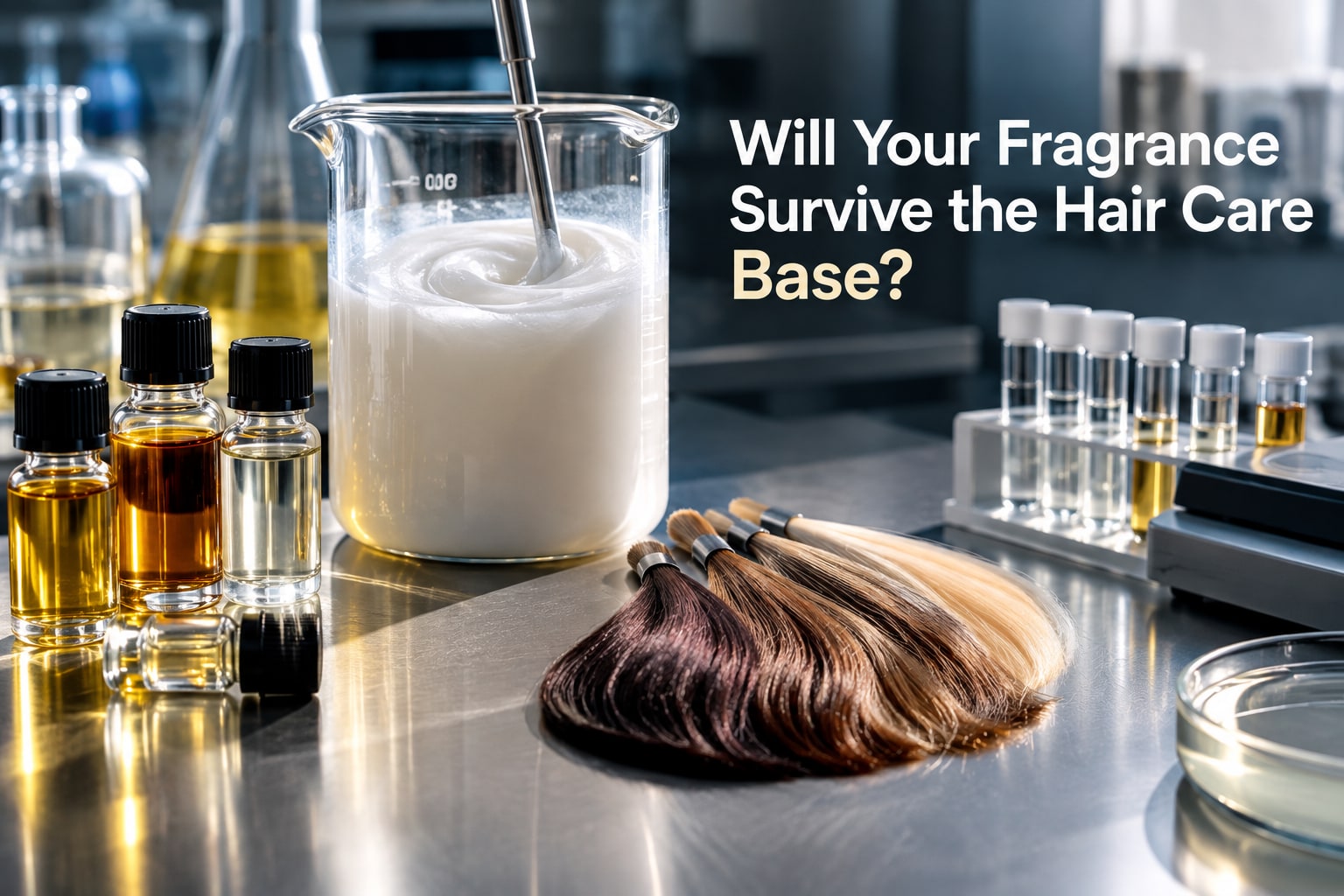
A fragrance that performs well on a blotter can disappear after rinsing, turn yellow in a clear shampoo, or clash with a conditioner base. By following the development workflow from technical brief through stability testing, documentation and approval, you can judge whether a proposed scent is suitable for your formula, market and production scale.
Key takeaways
- Define rinse-off or leave-on use before setting fragrance limits.
- Test fragrance in the finished shampoo, conditioner, or treatment base.
- Measure scent from wet application through dry-hair wear.
- Request IFRA documents, allergen data, stability results, and batch traceability.
How the product brief becomes a fragrance development brief
Fix the product category before discussing scent. IFRA maximum-use limits depend on exposure route, so “hair care” is not enough: identify the rinse-off or leave-on subcategory and the target market’s cosmetic rules.
1. State the product and base: shampoo, conditioner, mask, hair oil, serum, leave-in cream or styling product; provide the formula or list its surfactant system, pH, solids, solvent level, preservative system, colour and water content.
2. Give the intended fragrance dosage, batch size and manufacturing temperatures. A concentrate that works in a cool shampoo process can change during hot processing or behave differently at the final dosage.
3. Describe the pack, including clear or white appearance, bottle or tube material, closure and spray or pump mechanism. Packaging affects evaporation, leakage, staining and the scent released during use.
4. Define the sensory target for a custom hair care scent: reference fragrances, desired strength, wet-product character, lather or application impression, rinse-off impact and dry-hair persistence.
5. Flag known risks, including vanillin, natural extracts, oxidation-prone terpenes and coloured materials. Request low-peroxide raw materials and an antioxidant strategy where appropriate, but require testing in the finished base because yellowing and odour drift can still occur.
This information allows hair care fragrance solutions to use different solvent systems, dosage levels or substantivity strategies while preserving one brand identity across products.
How the fragrance is screened in the real hair care base
A fragrance is compatible only after it survives testing in the finished base; a good blotter evaluation proves almost nothing. The manufacturer prepares the hair care fragrance at its target dosage, adds it to the actual formula, and compares an unfragranced control for colour, clarity, viscosity, separation, foam and odour.
The screen uses the base’s pH, surfactant system, solvent level, preservative system, packaging and processing temperature. Inspect samples after filling and during storage for yellowing, haze, sediment, phase separation or odour drift. Vanillin, coloured materials, natural extracts and oxidation-prone terpenes deserve particular attention, especially in white and clear products.
| Product | What the screen focuses on | Typical failure |
|---|---|---|
| Shampoo | Surfactant compatibility, clarity, foam and rinse odour | Haze, weak foam or a sour note |
| Conditioner or mask | Cationic system, emulsion stability and deposition | Separation or greasy sensory feel |
| Oil or serum | Solubility, oxidation and packaging interaction | Sediment, rancid odour or discolouration |
| Styling product | Alcohol, polymers, propellants and dry-down | Cloudiness, tack or poor fragrance release |
A customize fragrances manufacturer should test each base separately rather than approve one concentrate for the whole range. The hair care fragrance may retain one olfactive identity while using different dosage levels, solvents or substantivity strategies. Confirm the product’s IFRA category before approval, because rinse-off and leave-on limits differ.
How performance is measured from wet product to dry hair
Compare fragrance impact at matched stages, not by smelling the concentrate in a bottle. Test the actual base on identical hair tresses or prepared swatches, using the same dosage, water temperature, rinse time and drying method for every sample.
| Product type | Application or lather | Rinse and towel-dry | Dry-down |
|---|---|---|---|
| Shampoo | Score odor release during wetting and lathering | Check what remains immediately after rinsing | Recheck after air-drying and several hours |
| Conditioner or mask | Score wet-hair coverage and creamy odor | Assess the scent after thorough rinsing | Compare towel-dry, air-dry and blow-dry substantivity |
| Leave-on cream, serum or oil | Assess application, spread and wet-hair character | Do not rinse; score after absorption and towel contact | Recheck after drying and several hours of wear |
Use a defined vocabulary such as fresh, floral, creamy, powdery, woody, harsh and clean, with reference standards so panellists score the same qualities. ISO 13299 provides a framework for building this sensory profile.
Record intensity and character at each checkpoint. A shampoo can smell powerful during lathering yet disappear after rinsing; a leave-on product can build slowly as solvents evaporate. Blow-drying can remove volatile materials faster than air-drying.
Choose hair care fragrance solutions for the exposure category: rinse-off and leave-on products require separate IFRA category checks, dosage decisions and substantivity strategies.
How stability, compliance and batch consistency are verified
Do not approve a custom hair care scent from a blotter result or a supplier’s generic “hair-care” limit. Fix the product’s IFRA category: rinse-off and leave-on hair products do not share one maximum use level.
Test the fragrance at its target dosage in the finished base and final package, because the same concentrate can change colour, odour release or stability across product formats.
Ask for an evidence pack containing:
- An IFRA Certificate of Conformity naming the exact category and maximum use level, plus an allergen declaration for the target market.
- A Safety Data Sheet and technical specification covering appearance, odour, density, refractive index and recommended storage.
- Finished-product stability results from real-time and accelerated studies, recording odour drift, discolouration, pH change, separation and package interaction.
- A batch Certificate of Analysis, approved reference sample and retained production sample for comparison.
Release each batch against the approved standard, not against memory. A trained sensory comparison can detect character changes, while laboratory checks such as gas chromatography fingerprinting, density or refractive index help investigate disputes. Set written tolerances before production; otherwise a batch can pass paperwork while smelling noticeably different on hair.
Compliance review must match the destination market. IFRA paperwork supports safe use but does not replace the buyer’s cosmetic safety assessment, ingredient review or local labelling obligations.
How approval, modifications and sourcing decisions affect the project
Expect a lab sample, not an automatic approval. The supplier should provide a coded fragrance sample, recommended dosage, IFRA certificate for the intended product category, allergen information, and evaluation instructions for your actual shampoo, conditioner, oil or serum.
Approve against agreed checkpoints: wet application, lather, rinse, towel-dry, air-dry and several-hour dry-down. Record intensity, character, substantivity, discoloration and base interaction. A sample that smells excellent on a blotter can disappear after rinsing or turn yellow in a clear shampoo.
Keep modifications controlled. Ask for one change at a time, with a revision code and retained reference sample, so you know whether a stronger top note, lower dosage or different solvent caused the improvement. Set a sample limit and approval deadline before development starts.
| Option | Advantage | Drawback |
|---|---|---|
| Custom fragrance | Distinct identity and tuned performance | More trials, testing and lead time |
| Stock fragrance | Fastest route and lower development effort | Less differentiation and weaker base fit |
| Adapted stock | Faster than a new creation with some tailoring | Original formula constraints remain |
| Fragrance-free | Simplifies allergen and odor concerns | Gives up sensory identity and masking |
A customize fragrances manufacturer is worth comparing on documentation, batch consistency, supply continuity and target-market compliance—not Colombo location alone. Choose custom when brand identity and dry-hair performance justify the work; choose stock or fragrance-free when speed, cost or sensitive-skin positioning dominates.
How to qualify a hair care fragrance manufacturer in Colombo
Ask a hair care fragrance manufacturer in Colombo for evidence, not a location-based assurance. Before approving development, ask:
- Which IFRA certificate and use level apply to this exact rinse-off or leave-on hair category?
- Can you provide allergen, raw-material, safety and target-market cosmetic compliance documents?
- Will you test the fragrance in our finished shampoo, conditioner, oil, serum or styling base at the proposed dosage?
- How will you check yellowing, separation, odor drift, peroxide risk and dry-hair substantivity?
- What batch records, retention samples and odor-matching controls support consistent supply?
Apply this checklist to Khattri Aromas LLP or any local candidate; Colombo helps with sampling and meetings, not proof of technical capability.
| Supplier type | Primary use | Evidence and testing |
|---|---|---|
| Fragrance supplier | Topical hair products | IFRA category certificate, cosmetic compliance, base compatibility and wet-to-dry sensory testing |
| Liquid flavour manufacturer | Oral products | Food-flavour documentation, oral-use safety review and flavour stability testing |
| Shared capability | Blending and quality control | Useful weighing and batch systems, but flavour dossiers do not replace skin-exposure or cosmetic requirements |
Related product
 | Fragrances hair care Fragrances Premium Hair Care Fragrance Solutions Tailored for Manufacturers At Khattri Fragrances, we specialize in developing premium-quality, customized... |
Frequently asked questions
What should a hair care fragrance development brief contain?
State the product type, rinse-off or leave-on use, target market, dosage range, scent direction, consumer profile, base formula, packaging, launch timing, and compliance requirements.
Why must fragrance be tested in the finished hair care base?
Shampoo surfactants, conditioners, oils, polymers, preservatives, pH, and packaging can change fragrance character and performance. Evaluate the actual formula rather than a fragrance blotter alone.
How is hair care fragrance performance measured?
Assess the product during opening, application, rinsing, wet hair, blow-drying, and dry-hair wear. Record intensity, character, odour defects, and persistence at defined time points.
Which documents should you request from a hair care fragrance manufacturer?
Request the IFRA Certificate of Conformity for the intended use, allergen declaration, ingredient or regulatory information, certificate of analysis, safety data sheet, stability results, and batch traceability records.
How do you qualify a hair care fragrance manufacturer in Colombo?
Review its technical brief process, in-base evaluation method, quality records, production controls, sample-to-batch consistency, document control, lead times, minimum order quantities, and modification process.