
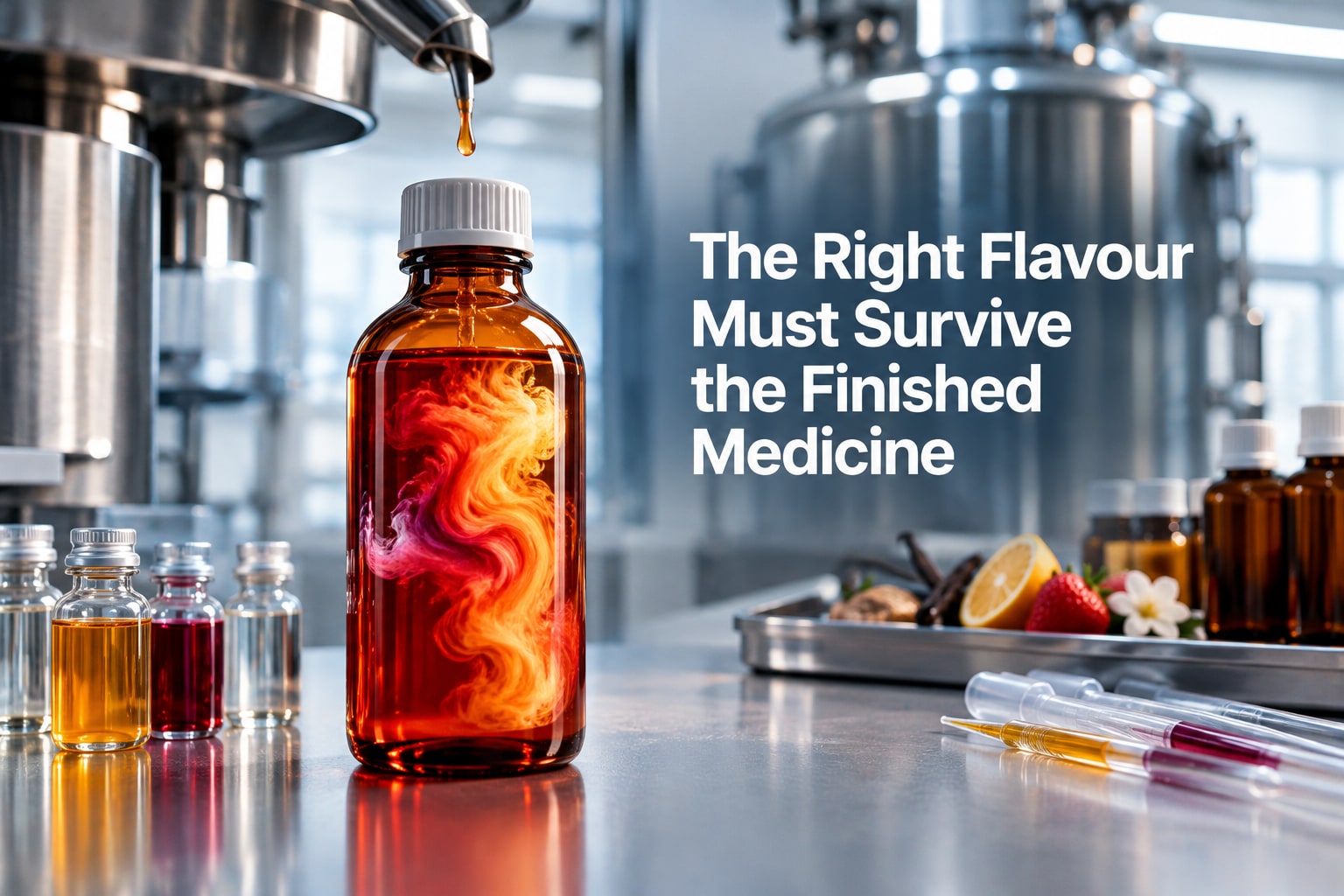
The right pharmaceutical flavour depends first on the dosage form, process, and finished formulation—not on whether the profile is strawberry, mint, or vanilla. By the end, you will be able to specify the flavour system, test its compatibility, compare suppliers, and approve a controlled path to commercial production.
Key takeaways
- Map the dosage form and process before selecting a flavour system.
- Use liquid systems for most liquids and powder systems for dry products.
- Test flavour in the finished medicine, including its carrier and active ingredients.
- Compare suppliers on documentation, batch consistency, and scale-up support.
Start with the dosage form and manufacturing process
Syrups, oral drops, suspensions, emulsions, and gargles usually start with liquid flavour systems; tablets, sachets, capsules, oral powders, and dry suspensions usually need powder systems. Map the dosage form and manufacturing process before choosing the flavour name.
A dry suspension may require a water-dispersible powder, while a wet-granulated tablet may need a heat-stable or encapsulated system. Liquid added to a dry blend creates local wetting, sticking, poor content uniformity, or premature granulation. Powder can segregate when its particle size, density, or flow differs from the active and excipients.
| Flavour system | Process fit | Main risk or requirement |
|---|---|---|
| Water-soluble liquid | Syrups, hot filling | Check heat and evaporation |
| Oil-soluble liquid | Emulsions | Confirm oil phase and separation control |
| Spray-dried powder | Tablets, sachets, dry blends | Protects volatiles; check hygroscopicity and cold-water dissolution |
| Encapsulated powder | Wet granulation, compression | Protects flavour from heat and shear |
| Heat-stable system | Hot filling, drying, sterilisation | Confirm flavour release after exposure |
| Water-dispersible powder | Dry suspensions | Must disperse uniformly after reconstitution |
| Fine powder | Roller compaction | Match density, particle size, and flow |
For a customize flavour for b2b pharmaceutical products in Colombo brief, choose the system that survives the process and releases flavour under the intended use condition. That is also the core rule for any customize flavour for b2b project: test the proposed carrier and thermal history, not a different laboratory sample.
Freshness in the drum means little if drying, compression, sterilisation, or storage destroys the flavour.
Match the carrier and flavour system to the formulation
The API and excipients decide flavour selection after the dosage form is fixed. A development brief must identify:
- API bitterness, dose, pH, buffer salts, sweeteners, sugar level, preservatives, alcohol content, viscosity, suspending agents, emulsifiers, and intended dilution.
- Whether the product must remain sugar-free, disperse in cold water, or suit a defined paediatric age group.
A liquid flavour manufacturer must disclose whether its carrier is water, ethanol, propylene glycol, glycerol, triacetin, or oil. Each changes volatility, solvent power, preservative partitioning, paediatric suitability, and the feasibility of a sugar-free design. An incompatible carrier can shift preservative performance, cloud the product, or leave an unsuitable alcohol or solvent load.
A powder flavour manufacturer should recommend spray-dried or encapsulated material when volatile notes need protection during drying, compression, storage, or dilution. Reject that option when hygroscopicity causes caking, moisture pickup damages flow, or the powder does not dissolve completely in cold water.
More flavour is not a complete bitterness solution. You may need sweeteners, acids, salts, cooling notes, viscosity changes, coating, ion exchange, complexation, or taste-masking polymers.
Review ethanol, propylene glycol, benzyl alcohol, benzoates, sugars, and intense sweeteners against the patient’s age, because safety, labelling, tolerability, and metabolic limits differ.
Test the flavour in the finished medicine, not in water alone
A flavour that tastes right in water can fail in the medicine. Prepare it in the complete pharmaceutical matrix at the intended use concentration, then test a dosage ladder with several measured levels below and above the supplier’s recommended range; never transfer an exact dosage from one product to another.
Evaluate each level after the actual dilution or administration route for:
- Bitterness, aftertaste, aroma release, mouthfeel, and overall acceptability
- Precipitation, colour change, phase separation, sedimentation, emulsion breaking, viscosity change, and pH drift
- Microbial status, API assay, marker-compound loss, new off-notes, and flavour loss during storage
Compare these samples:
| Sample | What it reveals | Required exposure |
|---|---|---|
| Unprocessed matrix | Baseline compatibility and sensory performance | No manufacturing step |
| Processed matrix | Flavour loss or instability caused by production | Planned heat, shear, drying, compression, or sterilisation |
| Aged packaged product | Shelf-life and distribution risk | Proposed container under justified hot, humid conditions |
For oral liquids, demand preservative-effectiveness evidence in the complete product. A flavour carrier can alter preservative partitioning and microbial risk, so the concentrate’s specification is not enough.
For a customize flavour for B2B pharmaceutical products in Colombo project, test the proposed bottle, blister, sachet, or foil barrier—not an open laboratory container. Review the finished medicine for the full proposed shelf life, including API assay, marker changes, pH, microbial status, and sensory acceptance.
Compare suppliers on more than flavour identity
A liquid flavour manufacturer and powder flavour manufacturer must be compared on process behaviour, not just aroma. Use this screening table:
| Option | Compare | Failure to detect |
|---|---|---|
| Liquid | Carrier, density, dosing accuracy, solvent limits, volatility, pump or line compatibility, batch consistency | Wrong density causes dosing error; volatile notes disappear; the carrier disrupts preservatives or equipment |
| Powder | Active flavour loading, carrier, moisture or water activity, bulk density, particle-size distribution, flow, dust control, dispersibility, caking, shelf life, transport conditions, blend segregation | A powder cakes, dusts, dissolves poorly, or separates from the blend |
Require a representative sample made with the same carrier, encapsulation load, and thermal history proposed for production. A different laboratory sample cannot prove scale-up performance.
Ask each supplier to state:
- Flavour profile, recommended use range, microbiological limits, allergen statement, residual solvents, storage conditions, and retest period
- Sensory criteria for aroma, taste, aftertaste, and batch-to-batch consistency
- Raw-material traceability and change-control notification for flavouring substances, carriers, site, or process
For customize flavour for b2b pharmaceutical work, test the sample in the finished medicine and its packaging. A Colombo buyer assessing Khattri Aromas LLP can use these questions to separate formulation support from a catalogue flavour and verify that commercial batches will meet the approved specification.
Use a documented path from brief to commercial batch
A reliable customize flavour for b2b pharmaceutical products in Colombo project begins with a complete brief, not a flavour name. Use the same documented path for every customize flavour for b2b request.
1. Provide the dosage form, target dose volume or mass, API names and levels, excipients, pH, alcohol and sugar content, preservative system, viscosity, processing temperature and shear, drying or compression method, packaging, storage conditions, patient age range, target market, and sensory goal.
Include the flavour profile, recommended use range, carrier and solvent limits, density or bulk-density range, moisture or water activity, microbiological limits, allergen statement, residual solvents, retest period, sensory criteria, traceability, and change-control requirements.
2. The supplier reviews the brief, checks flavouring-substance authorisation, carrier limits, allergen status, residual solvents, and toxicological or compendial justification for the target market, then prepares candidate samples. The buyer screens each sample in the finished matrix.
3. Both parties run compatibility, stability, and sensory checks, including API assay, physical appearance, microbiological status, flavour release, and storage performance in the proposed pack. Use a representative sample made with the production carrier, encapsulation load, and thermal history.
4. The supplier scales up the approved process; quality teams approve the specification; each commercial batch is released against identity, physical, microbiological, and sensory criteria. Select liquid, powder, spray-dried, encapsulated, water-soluble, oil-soluble, or heat-stable flavour only after it passes finished-product tests and documentation review.
Frequently asked questions
How do you choose a flavour system for a pharmaceutical product?
Start with the dosage form and manufacturing process. Syrups, oral drops, suspensions, emulsions, and gargles usually use liquid flavour systems, while tablets, sachets, capsules, oral powders, and dry suspensions usually use powder systems.
Why must pharmaceutical flavour be tested in the finished medicine?
Water alone does not reproduce the taste, texture, pH, sweetness, viscosity, active ingredients, preservatives, or carrier of a finished medicine. Test the flavour in the actual formulation and at the intended use level.
What should you compare when selecting a pharmaceutical flavour manufacturer?
Compare flavour identity alongside carrier compatibility, dosage guidance, technical documents, allergen and regulatory information, batch consistency, sample support, lead times, and scale-up capability.
What should a documented flavour development process include?
Record the product brief, dosage form, process conditions, target flavour, sample versions, use levels, test results, approved specification, packaging requirements, and the conditions for the first commercial batch.